Cook Street Village Real Estate for Sale
Homes around the village fall into three groups. Condos are the largest, most of them in low-rise buildings from the 1960s through the early 1990s on the side streets off Cook: Hilda, Southgate, Collinson, Richardson, Park Boulevard and the Fairfield Road blocks. A smaller number of newer buildings sit near the edge of Beacon Hill Park. Detached houses make up the second group, many from Fairfield's Edwardian building boom, with mid-century homes and newer infill between them. The third is the big character house divided into suites, sold whole as a multi-unit property or as individual strata units.
Because the area is so compact, price differences come mostly from the type, age and condition of a home rather than its address. A two-bedroom condo two blocks from the shops and a heritage house near Moss Street share the same short walk to Cook Street, so searching by home type first usually narrows the choice faster than searching by street. The Cook Street Village condos for sale page looks at the condo side in detail.
How This Page Draws Cook Street Village
The City of Victoria's Fairfield Neighbourhood Plan, approved by Council on September 12, 2019, designates Cook Street Village as a Large Urban Village, the larger of the two village types in the City's plans. The shops run along Cook Street around Oliphant Avenue, Sutlej Street, Pendergast Street and May Street, and the plan allows commercial uses to be considered along Cook Street north to Fairfield Road.
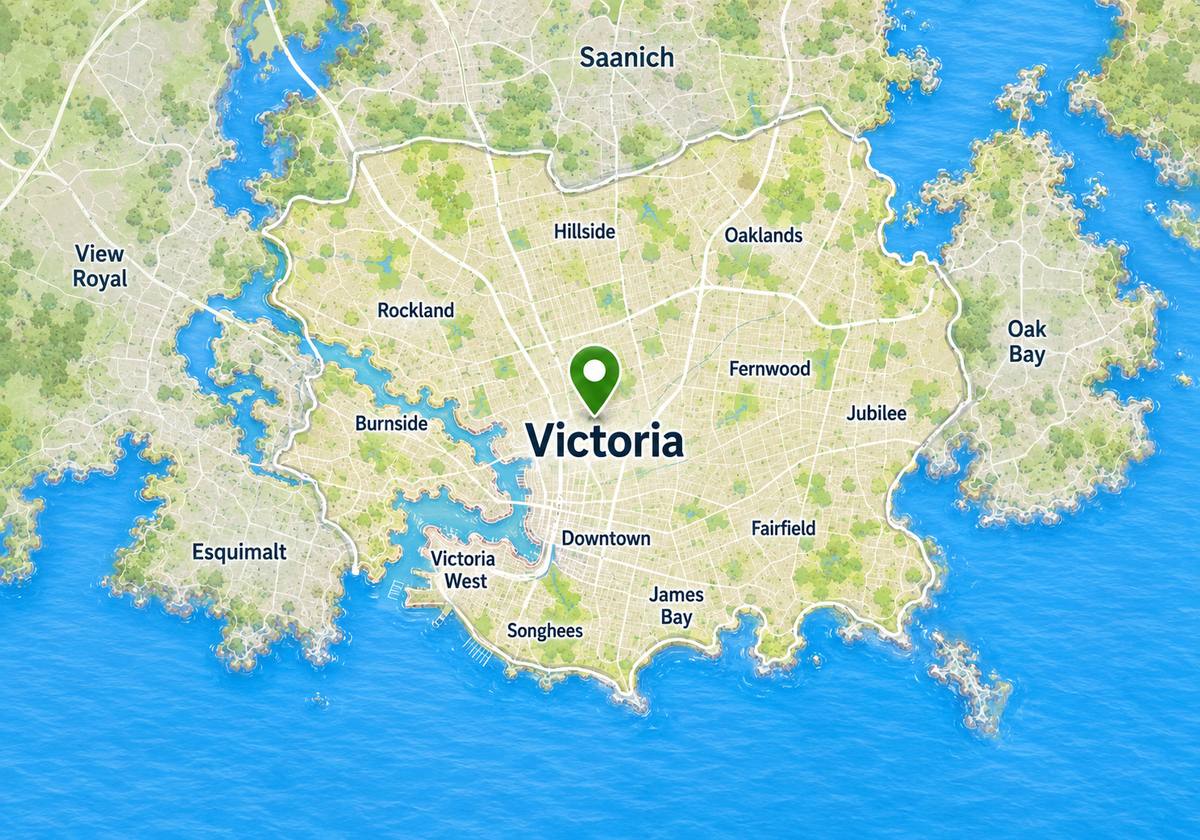
There is no MLS® boundary for the village, so this page uses a simple rule: it shows listings within about 800 metres, roughly a 10-minute walk, of the middle of the village. The line stops at the edge of Beacon Hill Park so that James Bay homes on the far side of the park are left out. In practice the area reaches north past Fairfield Road, east to about Moss Street and south to the Dallas Road waterfront.
Fairfield West, Fairfield East and the Village
On the MLS®, homes near the village are filed under Fairfield West and, toward Ross Bay, Fairfield East. For the whole neighbourhood, start with Fairfield real estate. Use this page when being able to walk to Cook Street for groceries and coffee is the point.
What the Fairfield Plan Allows Around the Village
For a buyer, the plan matters because it describes what could be built next door. In the village itself, mixed-use and apartment buildings are limited to 13.5 metres, about four storeys, with a base density of 1.5 floor space ratio (FSR) and bonus density up to 2.5. Ground floors are meant to stay commercial, with homes above the shops.
| Area | What the Fairfield plan supports |
|---|
| Cook Street Village | Mixed-use buildings up to 13.5 m (about four storeys), base 1.5 FSR, bonus up to 2.5 FSR, shops at street level and housing above |
| Urban Residential, west of the village | Small apartment buildings up to four storeys, base up to 1.2 FSR, bonus up to about 2:1 |
| Block bounded by the village, Oscar, Chester and McKenzie Streets | Townhouses and other infill rather than new apartment buildings |
| East of the village | Townhouses, conversions, houseplexes, duplexes and suites, but not new apartment buildings |
| Traditional Residential streets | Infill housing at up to about 1:1 FSR |
Zoning, not the plan, decides what a particular lot can do today, and the provincial small-scale multi-unit housing legislation passed in 2023 also applies to many residential lots in Victoria. Check the current zoning for any address with the City before counting on a suite, a garden suite or extra units.
The Chestnut Trees and the Shape of the Street
What makes the village recognizable is its canopy of mature horse chestnut trees, planted in a wide boulevard and spreading over the sidewalk patios. The Fairfield plan commits the City to protecting and renewing that canopy, and when an aging chestnut has to come down, the replacement is meant to be another horse chestnut.
The Cook Street Village Design Guidelines, adopted with the plan in 2019, describe the rest of the character: shops, restaurants and cafés that spill onto the sidewalk, side streets that meet Cook Street at T-intersections, and gentle curves in the road at either end that act as gateways. New buildings on Cook Street are capped at four storeys and 13.5 metres, need ground floors at least 4 metres high for shops, and step back from the street, on average 2 metres at the first storey and 5 metres above the second. Storefronts are meant to be broken into modules roughly 8 to 10 metres wide, so even new buildings keep the small-shop rhythm.
For condo buyers, those rules shape the view from the window. A new building across the street can be four storeys but no taller, and its upper floors will be set back from the sidewalk.
Beacon Hill Park Next Door
Beacon Hill Park, at 100 Cook Street, is the village's back garden: roughly 740,000 square metres of lawns, flower beds, ponds, footpaths and Garry oak meadow that the City calls the crowning jewel of its park system. It was set aside as a public park in 1858. There is a ball diamond, tennis and pickleball courts, lawn bowling, sports fields, playground equipment and a picnic shelter, and the protected areas include Garry oak ecosystem and the threatened yellow montane violet. Mile Zero, the western end of the 8,000-kilometre Trans-Canada Highway, is at the park's southwest corner on Dallas Road.
Dogs must be leashed throughout the park except in the leash-optional area south of Dallas Road, and the City keeps dogs out of playgrounds everywhere.
The Dallas Road Waterfront
A few blocks south, Dallas Road runs along the bluffs above the Strait of Juan de Fuca, with the Olympic Mountains across the water. The grassy strip south of the road is the City's best-known leash-optional area, busy with dog walkers from early morning, and the steady onshore winds bring out kite flyers, paragliders and windsurfers. The Fairfield plan includes a waterfront cycling route along Dallas Road and names Cook Street as one of the crossings to assess for safety. Further east, Clover Point reaches into the strait and the Ross Bay seawall leads on toward Gonzales.
Ross Bay Cemetery and Fairfield's Past
Fairfield takes its name from Fairfield Farm, a large property owned by Sir James Douglas, the Hudson's Bay Company officer who founded Fort Victoria. Joseph Trutch, later British Columbia's first Lieutenant Governor, built a house called Fairfield on Trutch Street in 1861. Fairfield Road linked the area to town in 1890, streetcar lines followed in 1909, and most of the neighbourhood was built in the boom between about 1900 and 1913, which is why Edwardian houses still line so many streets near the village.
The Fairfield plan also records that seasonal marshes once ran through what is now Cook Street Village toward the Inner Harbour, rich in fish and wildfowl. To the east, Ross Bay Cemetery, on land once held by Isabella Ross, British Columbia's first female landowner, is where the painter Emily Carr is buried.
Daily Life in the Village
Most errands can be done on foot. Cook Street's cafés, restaurants, grocers and small shops spill onto the sidewalk under the chestnuts, and the side streets are quiet a block away. The Cook Street Village Activity Centre runs social, educational, wellness and recreational programs for older adults, Fairfield Community Place serves the wider Fairfield and Gonzales area, and on Saturdays the long-running Moss Street Market sets up at Sir James Douglas School and Robert Porter Park on Moss Street.
Getting Around from Cook Street Village
Downtown Victoria is less than two kilometres north, about a 20- to 25-minute walk or a short ride by bike. BC Transit's route 7 connects Fairfield with downtown and the University of Victoria, and its late-night trips run as the 7N via Cook Street Village. Fairfield Road, a few blocks north, is one of the City's frequent transit routes. The Fairfield plan also proposes an all-ages cycling route across Beacon Hill Park, and calls for a parking strategy that balances shop loading on Cook Street with resident parking on the side streets.
Schools & Families
Fairfield is in the Greater Victoria School District (SD61). The Fairfield plan names Sir James Douglas Elementary and Margaret Jenkins Elementary in the neighbourhood, and South Park Community School on the far side of Beacon Hill Park, which the proposed cycling route across the park would link to the village. Catchments change, so confirm the schools for any address with the district.
Who Buys Near Cook Street Village
The village draws downsizers from houses elsewhere in Victoria and Oak Bay who want a home they can lock and walk away from, first-time buyers in the older one- and two-bedroom condos, professionals who walk or cycle downtown, and families in the character houses within reach of the neighbourhood's elementary schools.
Investors like the steady rental demand, but two rules shape the numbers. Since November 2022, BC strata bylaws can no longer ban or cap long-term rentals, and under the province's short-term rental rules a short-term rental in Victoria has to be in the host's principal residence, so a condo here cannot be run as a full-time vacation rental.
Before You Buy Near the Village
- Parking: many older buildings and houses near Cook Street rely on street parking. Confirm exactly what comes with the home.
- Street life: homes facing Cook Street get the patios, deliveries and events, and the plan supports trial street-end closures and parklets. A home a block off Cook is usually quieter.
- Next door: check the plan designation of neighbouring lots in the table above before paying for a view or sunlight.
- Heritage: some Fairfield houses are heritage-registered or designated, which affects exterior changes, so check the City's register for any house you are considering.
- Strata records: for older low-rises, read the depreciation report, recent minutes and any special levies.
For the general steps of buying a home here, see the buyer's guide.
How Cook Street Village Compares
For the whole neighbourhood, start with Fairfield real estate or Fairfield condos, and for the city as a whole, Victoria real estate. Two other village pages cover similar walkable shopping streets: Quadra Village, north of downtown, and Oak Bay Village on Oak Bay Avenue.