Sooke Neighbourhood Guide
Explore Sooke real estate, neighbourhoods, homes, condos, townhomes, waterfront properties, acreages, ocean views, lifestyle, history, and MLS® listings on Vancouver Island’s southwest coast.
Sooke BC Real Estate, Lifestyle & Area Information
Sooke is one of the most distinctive real estate markets in Greater Victoria, offering a west coast mix of oceanfront homes, rural acreages, newer family subdivisions, townhomes, condos, building lots, forested properties, and ocean view homes near some of the most dramatic natural scenery on southern Vancouver Island.
Unlike the inner-core neighbourhoods of Victoria, Oak Bay, Saanich, or Esquimalt, Sooke is not simply another urban residential market. It has a more rural and coastal character, with greater emphasis on space, privacy, outdoor recreation, waterfront access, larger lots, and relative affordability compared with many central Greater Victoria communities.
The trade-off is distance. Buyers looking at Sooke should be realistic about commuting time, Highway 14 traffic, daily travel to Langford, Colwood, View Royal, Esquimalt, downtown Victoria, or the Saanich Peninsula, and whether the lifestyle advantages outweigh the extra time behind the wheel.
You can also compare Sooke properties, Sooke houses, Sooke condos, Sooke townhomes, Sooke waterfront homes, Sooke view homes, and Sooke land and acreages.
Sooke Real Estate Overview
Sooke real estate includes a broad range of property types. Buyers may find detached houses, newer subdivision homes, townhomes, condos near the town centre, rural acreages, building lots, waterfront homes, ocean view properties, revenue properties, hobby farm options, and homes close to beaches, marinas, forests, trails, schools, and local amenities.
For many buyers, Sooke offers something increasingly difficult to find closer to Victoria: more land, more privacy, more natural surroundings, and better relative value. That appeal is real, but so are the practical considerations. Commute time, servicing, road access, septic systems, wells, slope, drainage, insurance, zoning, and wildfire interface exposure can matter much more here than they do in a standard urban neighbourhood.
Why Buyers Choose Sooke
Buyers often consider Sooke because of affordability, natural beauty, ocean access, outdoor recreation, larger lots, newer family homes, waterfront opportunities, and a more relaxed west coast lifestyle. It can appeal to first-time buyers, families, retirees, investors, contractors, remote workers, outdoor enthusiasts, and buyers priced out of more central Greater Victoria markets.
The lifestyle is a major part of the appeal. Sooke offers access to hiking, fishing, kayaking, boating, surfing, beachcombing, whale watching, camping, mountain biking, and coastal exploring. Nearby destinations include Sooke Potholes Regional Park, East Sooke Regional Park, Whiffin Spit, French Beach, Jordan River, the Juan de Fuca Marine Trail, and the rugged beaches and forests that define the west coast of Vancouver Island.
Sooke Buyer Reality Check
Sooke can offer excellent value, scenery, privacy, and lifestyle, but it is not the right fit for every buyer. Before purchasing, test the commute, consider your daily schedule, review road access, understand rural servicing, and compare the property’s lifestyle appeal against the practical costs of travel, maintenance, utilities, insurance, and long-term resale demand.
Living in Sooke
Living in Sooke feels different from living in Victoria, Oak Bay, Saanich, or the inner Westshore. The community has a stronger connection to ocean, forest, trails, marinas, fishing, beaches, and west coast recreation. It can feel more casual, more spread out, and more rural than buyers coming from the city core may expect.
Sooke also has everyday amenities, including grocery stores, local shops, schools, restaurants, professional services, recreation facilities, healthcare services, and small businesses. As the community has grown, the range of housing and services has expanded, but Sooke still retains a small-town and coastal character that separates it from the denser parts of Greater Victoria.
Sooke Neighbourhoods and Local Areas
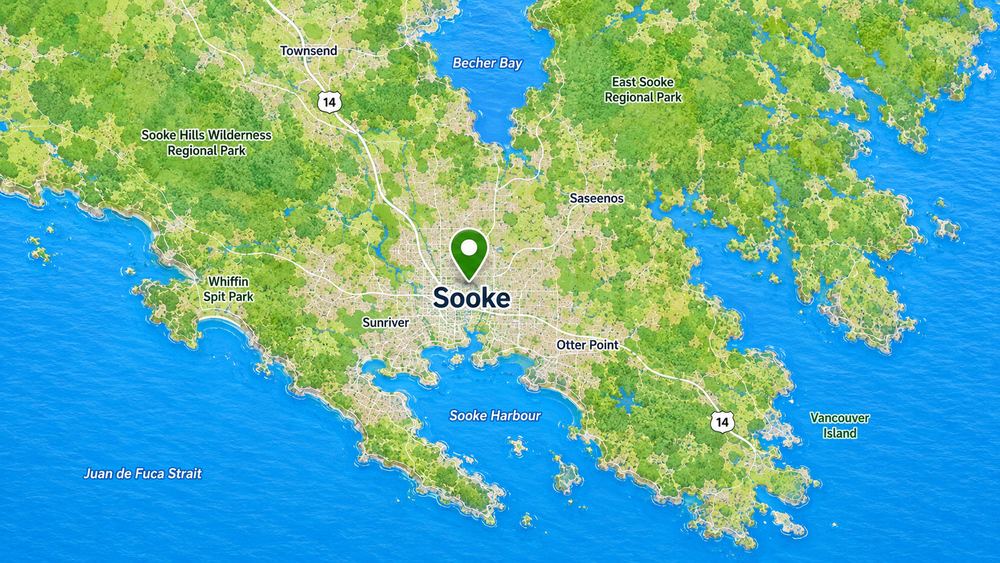
Sooke is not a single uniform housing market. The town centre, Whiffin Spit, Sooke Harbour, Sooke Basin, Sunriver, Broomhill, Saseenos, Otter Point, East Sooke, and more rural outlying areas can feel very different from one another. Some areas are more convenient for shopping and schools, while others offer more privacy, views, acreage, or waterfront exposure.
Buyers should compare each area based on property type, commute route, road quality, exposure, lot size, servicing, view quality, access to amenities, and whether the home is in a more residential, rural, waterfront, or forested setting.
Sooke Houses for Sale
Sooke houses for sale may include older homes near the town centre, newer family homes in expanding subdivisions, custom homes on larger lots, homes with suites, rural houses with workshops or outbuildings, and waterfront or ocean view homes along the coastline and Sooke Basin.
House buyers should compare location, lot size, commuting distance, road access, zoning, suite potential, septic or sewer connection, water supply, slope, drainage, exposure, privacy, condition, and whether the home is close to schools, shops, transit, parks, trails, or beaches.
Sooke Condos
Sooke condos may appeal to buyers looking for a lower-maintenance home, a more affordable entry point, or a lock-and-leave option near the town centre, waterfront, harbour, or local services. Some condo buildings may offer ocean views, walkability, parking, storage, elevator access, and easier access to shops and amenities.
Condo buyers should review strata documents carefully, including bylaws, depreciation reports, insurance, contingency reserve funds, rental rules, pet rules, parking, storage, building age, maintenance history, and whether the monthly strata fees make sense for the building and services provided.
Sooke Townhomes and Strata Homes
Sooke townhomes can be a practical middle ground for buyers who want more space than a condo but less maintenance than a detached house. Townhomes may appeal to families, downsizers, first-time buyers, and buyers who want a residential setting without taking on a larger rural property.
Townhome buyers should pay close attention to strata fees, exterior maintenance responsibilities, parking, yard use, pet bylaws, rental bylaws, insurance, depreciation reports, building envelope condition, and whether the complex is positioned for long-term value in the Sooke market.
Waterfront Properties in Sooke
Sooke waterfront homes are among the area’s most distinctive property types. Buyers may find homes along Sooke Harbour, Sooke Basin, Whiffin Spit, East Sooke, Otter Point, and other coastal locations with ocean views, beach access, rugged shoreline, moorage potential, or private west coast settings.
Waterfront buyers should investigate shoreline conditions, erosion, floodplain considerations, setbacks, septic systems, well or water service, slope stability, insurance, access, docks or foreshore permissions, exposure to storms, and whether the property is practical for year-round living.
Ocean View Homes in Sooke
Sooke view homes may offer outlooks over the Sooke Basin, Sooke Harbour, Strait of Juan de Fuca, Olympic Mountains, forested hillsides, or surrounding coastline. View homes can vary dramatically in value depending on view quality, privacy, elevation, exposure, road access, and how well the home is oriented toward the outlook.
Buyers should distinguish between partial views, filtered views, seasonal views, and protected long-term views. Future development, tree growth, neighbouring properties, topography, and zoning can all affect the long-term value of a view property.
Sooke Acreages and Rural Properties
Sooke acreages and rural properties may offer privacy, workshops, gardens, hobby farming potential, outbuildings, guest accommodation, forested land, trails, and room for equipment, boats, RVs, or home-based activities. These properties can be attractive, but they often require more due diligence than standard suburban homes.
Acreage buyers should review zoning, ALR status where applicable, septic systems, wells, water quality, drainage, access roads, slope, wildfire exposure, tree maintenance, outbuildings, permits, insurance, and whether the land is actually usable or mostly steep, forested, wet, rocky, or environmentally constrained.
Building Lots and Land in Sooke
Sooke land for sale may include residential building lots, rural parcels, ocean view lots, acreage properties, redevelopment sites, and land suitable for custom homes. Land can offer flexibility, but it can also be more complex than buying an existing home.
Buyers should verify zoning, permitted uses, development permits, servicing, wells, septic approval, road access, hydro, geotechnical conditions, environmental restrictions, tree protection, riparian areas, building envelope, and total construction costs before relying on a lot as a simple building opportunity.
Pet-Friendly Living in Sooke
Sooke can be a strong fit for buyers with pets because many properties offer more outdoor space, trails, beaches, fenced yards, and access to nature than buyers often find in denser urban markets. Detached homes, townhomes, acreages, and some condos may all work for pet owners depending on the property, bylaws, yard use, and location.
Pet owners should pay close attention to fencing, road exposure, wildlife, strata pet bylaws, yard access, nearby parks, trail access, livestock or rural-neighbour conflicts, and whether the property is practical for daily pet care in wet west coast weather.
Commuting from Sooke
The commute is one of the most important practical issues for Sooke buyers. Sooke can offer better value and more space, but travel times to Langford, Colwood, View Royal, Esquimalt, downtown Victoria, and the Saanich Peninsula can be significant, especially during peak periods.
For buyers who work from home, have flexible schedules, work locally, or prioritize lifestyle over commute time, Sooke can make excellent sense. For buyers who need to drive into central Victoria every day, the commute should be tested carefully before purchasing.
Sooke Due Diligence Checklist
When comparing Sooke homes, review commuting time, road access, zoning, strata documents where applicable, septic systems, wells, water supply, drainage, slope stability, wildfire interface exposure, floodplain considerations, oceanfront setbacks, insurance, suite legality, outbuilding permits, and long-term resale appeal.
A Historic Coastal Community
Sooke has a history that is much deeper than its current role as a growing residential community west of Victoria. When the Hudson’s Bay Company established Fort Victoria at Camosun in 1843, European settlement began to expand throughout southern Vancouver Island. One of the earliest independent land purchasers in the newly formed Colony of Vancouver Island was Captain Walter Colquhoun Grant of the Royal Scots Greys, who acquired land at Sooke Harbour in 1849.
A monument commemorating Grant was erected in 1958 during British Columbia’s Centennial, but his most visible legacy may be less formal. The Scottish broom seeds he planted produced the bright yellow blooms that later spread widely along the west coast from Alaska to California.
Walter Grant, the Muir Family and Early Sooke
After Grant returned to Britain in 1853, his Sooke holdings passed to John and Anne Muir, Scottish immigrants who had arrived on Vancouver Island in 1849. The Muir family had originally been connected with Hudson’s Bay Company efforts to search for coal, including at Fort Rupert, but by 1851 they had settled on land in Sooke.
The Muir family played a major role in shaping early Sooke. Grant had built a water-powered sawmill, but the Muirs developed the area’s lumber, farming, and shipbuilding economy on a larger scale. By 1855, they had established a steam-powered sawmill, created a thriving farm, and constructed multiple seafaring vessels.
Their lumber markets extended far beyond Vancouver Island, reaching San Francisco, South America, the Sandwich Islands, now Hawaii, and Australia. In 1884, the Muir sons built three impressive homes, two of which, Woodside and Burnside, remain important reminders of Sooke’s early settlement history.
The T’Sou-ke People and Early Industry
Members of the T’Sou-ke community were involved in many aspects of Sooke’s early economic life, including sawmill work, barrel stave production, bark collection for the tanning industry, and other tasks connected with the region’s forestry and coastal economy.
Other families also became part of Sooke’s early immigrant history, including the Brule and Poirer families, who came from Quebec by following the old fur trade routes. These overlapping Indigenous, Scottish, French Canadian, forestry, fishing, and maritime histories helped shape the community long before Sooke became a modern residential market.
Forestry, Fishing and the Sooke Economy
Forestry was one of the major forces behind Sooke’s early growth. The region’s immense rainforests contained Douglas Fir, Western Red Cedar, Sitka Spruce, and Hemlock, attracting logging operations that supported the local economy and contributed to the provincial treasury for generations.
In the early 1900s, commercial fish traps became a major part of Sooke’s economy. These fish traps used driven piles and netting placed to intercept salmon and remained important until independent fishing fleets eventually displaced the fish trap industry by the middle of the twentieth century.
Although Sooke has changed significantly, this history still matters. The area’s real estate identity is tied to forestry, fishing, rural land, working waterfront, Indigenous history, pioneer settlement, and a rugged coastal geography that still shapes how people experience the community today.
Buying a Home in Sooke
When buying a home in Sooke, buyers should evaluate the property type first. A newer subdivision home, rural acreage, waterfront residence, townhome, condo, building lot, and ocean view property may all appear under the same Sooke MLS® search, but they require very different due diligence.
The best Sooke purchases usually come from understanding both the value and the trade-offs. Space, scenery, affordability, and lifestyle matter here, but so do commute, services, property condition, water, septic, zoning, insurance, and long-term resale appeal.
Sooke MLS® Listings
Use this page to learn about Sooke and compare current Sooke MLS® listings, including houses, condos, townhomes, waterfront homes, ocean view homes, acreages, building lots, rural properties, pet-friendly homes, and investment properties in Sooke BC.
Browse current Sooke properties for sale and compare listings by price, location, property type, land size, view quality, waterfront exposure, building condition, zoning, servicing, commute time, recreation access, and long-term ownership fit.