Exceptional Walkability
Downtown, the Inner Harbour, Parliament Buildings, Beacon Hill Park, James Bay Village and the waterfront are all within a compact area.


Real Estate Company

Explore one of Victoria's oldest and most distinctive residential neighbourhoods, bordered by the Inner Harbour, the Outer Harbour, Dallas Road waterfront and Beacon Hill Park.
James Bay occupies a compact peninsula immediately south and southwest of Downtown Victoria. It is bounded by the Inner Harbour and Legislative precinct to the north, the Outer Harbour and Fisherman's Wharf area to the west, the Strait of Juan de Fuca and Dallas Road waterfront to the south, and Beacon Hill Park along much of its eastern edge.
This geography gives James Bay an unusual combination of urban convenience and coastal access. Residents can walk to Downtown offices, restaurants and cultural attractions while also living close to shoreline paths, marinas, parks, beaches, neighbourhood shops and some of the city's best-known public spaces.
Housing is equally varied. James Bay contains detached character houses, modest cottages, converted residences, townhomes, older apartment buildings, concrete high-rises, leasehold properties, newer condominiums and premium waterfront residences. Buyers should therefore compare the building, tenure, exact block and property type rather than treating the neighbourhood as one uniform market.

Downtown, the Inner Harbour, Parliament Buildings, Beacon Hill Park, James Bay Village and the waterfront are all within a compact area.
Harbour and ocean access shape the neighbourhood, with Fisherman's Wharf, Ogden Point, Dallas Road and the Strait of Juan de Fuca close at hand.
Character houses and cottages sit beside high-rise apartments, strata condos, townhomes, leasehold properties and newer infill.
James Bay contains some of Victoria's oldest surviving residential buildings and streets, along with later 20th-century apartment redevelopment.
James Bay works particularly well for buyers who want to reduce their dependence on a car. From much of the neighbourhood, residents can walk into Downtown, reach the Inner Harbour, shop for daily necessities in James Bay Village, use neighbourhood transit, visit Beacon Hill Park or follow the shoreline toward Fisherman's Wharf and Dallas Road.
The neighbourhood also has a distinctly quieter residential side. Streets south of the Legislative precinct contain mature landscaping, cottages, character houses, low-rise apartments and small-scale infill. This creates a different living experience from Downtown even though the two neighbourhoods are immediately adjacent.
Tourism is part of James Bay's identity. The Parliament Buildings, Royal BC Museum precinct, Inner Harbour, Fisherman's Wharf, cruise-ship terminal at Ogden Point and waterfront routes bring visitors into the area. Some buyers enjoy that energy and convenience; others prefer quieter interior streets away from the busiest visitor corridors.
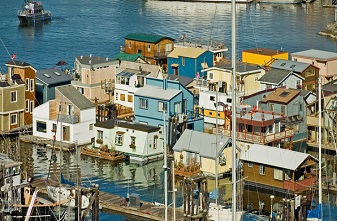

James Bay is compact, but the experience changes considerably between the Inner Harbour, Village, Dallas Road and Outer Harbour edges.
The northern edge of James Bay is dominated by the Parliament Buildings, hotels, museums, tourist activity and immediate access to Downtown. Residential buildings here can trade heavily on harbour views and walkability.
The Menzies Street commercial node provides neighbourhood shops and services within a predominantly residential setting. The City continues to identify the Village as the local commercial and community focus.
The western side has a stronger marine character, with marinas, floating homes, harbour activity, shoreline routes and proximity to Ogden Point.
Southern James Bay opens toward the Strait of Juan de Fuca and Olympic Mountains. Properties may benefit from coastal access and views, but exposure, wind and marine weather become more relevant.
Homes near the eastern side of James Bay enjoy immediate access to one of Victoria's largest parks while remaining close to Downtown and the waterfront.
Between the major edges are quieter blocks containing character houses, cottages, apartments, converted homes, townhouses and mature landscaping.
Condominiums represent a major part of the James Bay market. Inventory can include older low-rise apartments, large concrete towers, leasehold buildings, boutique strata projects, waterfront residences and newer luxury construction. Building age, tenure, parking, elevators, depreciation planning, insurance and view quality can materially affect value.
Browse James Bay condos →Detached homes are less common and range from modest cottages to substantial renovated character houses. Buyers should evaluate foundations, drainage, wiring, plumbing, sewer laterals, oil-tank history, permits, seismic work, heritage restrictions where applicable and suite legality.
Browse James Bay houses →Townhomes offer a middle ground between apartment living and detached ownership. They can include traditional strata complexes, row homes, character conversions and newer infill, with parking and private outdoor space varying widely.
Browse James Bay townhomes →Premium properties may face the Inner Harbour, Outer Harbour, Strait of Juan de Fuca or Olympic Mountains. Buyers should distinguish true waterfront from water views and consider future view protection, marine exposure, building condition and exact orientation.
Browse James Bay waterfront properties →The most important mistake to avoid is comparing James Bay properties only by price and square footage. A leasehold apartment, older freehold strata condo, renovated character house, waterfront unit and concrete high-rise residence can have completely different ownership structures, maintenance risks and resale characteristics.
For condos and townhomes, review strata minutes, depreciation reports, contingency funding, insurance, special levies, building-envelope history, plumbing, elevators, balconies, parking, storage, pets, rentals and EV charging. Confirm whether the property is freehold strata or another tenure form before comparing it directly with alternatives.
For houses, pay close attention to the realities of older Victoria housing: foundations, drainage, electrical systems, plumbing, sewer connections, buried oil tanks, additions, permits, seismic upgrades and heritage status. Lot size and parking can also be limited compared with suburban neighbourhoods.
The James Bay peninsula is part of the traditional territory of the Lekwungen-speaking peoples. The City of Victoria's current Indigenous wayfinding identifies James Bay with the Lekwungen name sxʷeŋxʷəŋ təŋəxʷ, reflecting a history that predates colonial settlement by thousands of years.
After Fort Victoria was established in 1843, the Hudson's Bay Company developed Beckley Farm on the peninsula to help provision the fort. As Victoria expanded from trading post to colonial capital, the farm lands were progressively subdivided and James Bay became one of the earliest residential areas outside the fort and commercial core.
James Bay was named for James Douglas, Hudson's Bay Company officer, governor and one of the central figures in early colonial Victoria. By the late nineteenth and early twentieth centuries, the neighbourhood contained grand houses, modest worker cottages, government buildings and industrial activity associated with the harbour.
The shoreline was historically very different from what residents see today. Early James Bay included tidal mudflats near the present Inner Harbour causeway, while bridges, wharves and harbour infrastructure gradually reshaped access between the neighbourhood and the commercial core.
The completion of the Legislative Buildings in 1898 reinforced James Bay's role as the seat of provincial government. At the same time, industrial and marine activity expanded around the Outer Harbour and Ogden Point, while residential development filled much of the peninsula.
Postwar redevelopment changed the neighbourhood dramatically. Many older houses were demolished and replaced with apartment towers during the 1960s and early 1970s. Community opposition to continued demolition helped push Victoria toward stronger heritage conservation and more sensitive infill, leaving today's James Bay with an unusually visible mixture of nineteenth-century houses, early apartments, mid-century towers and contemporary development.
Current City planning continues to treat James Bay as a dense mixed-use neighbourhood with a broad range of housing types and a major visitor, government and harbour role. Policy direction emphasizes maintaining housing diversity, supporting sensitive infill, adapting existing buildings and concentrating neighbourhood commercial activity around James Bay Village and the Legislative precinct.
For buyers, this means nearby development potential matters. Before purchasing a property primarily for privacy, sunlight or views, review surrounding zoning, development applications and the physical relationship between the property and neighbouring sites.

Explore current James Bay residential listings by property type, location, price, building age, tenure, waterfront exposure, views and housing style.
View James Bay PropertiesNOTE: MLS® property information is provided under copyright© by the Vancouver Island Real Estate Board and Victoria Real Estate Board. The information is from sources deemed reliable, but should not be relied upon without independent verification. This website may only be used by consumers for the purpose of locating and purchasing real estate. By registering on this website I/We consent to the collection, use and disclosure of personal information as described in our privacy policy.
The trademarks MLS®, Multiple Listing Service® and the associated logos are owned by The Canadian Real Estate Association (CREA) and identify the quality of services provided by real estate professionals who are members of CREA. Used under license.