How a 55+ Rule Is Allowed
BC's Human Rights Code generally prohibits age discrimination in tenancies, but section 10(2)(b)(i) exempts premises where every unit is reserved for a person who has reached 55, or for two or more people, at least one of whom has reached 55. That second part matters to couples: a younger spouse or partner can live in a 55+ park home as long as one resident qualifies.
The Manufactured Home Park Tenancy Regulation builds on that exemption. When a home in a 55+ park is sold and the tenancy is assigned, the buyer's request must include proof of age, and the landlord may refuse the assignment if no one who will live in the home qualifies. Age is not one of the purposes the regulation lists for park rules, so ask how a park's 55+ status is set out and get it in writing, usually in the tenancy agreement.
55+ Bylaws in Bare Land Stratas
In a bare land strata, the age rule is a bylaw. Since November 24, 2022, the Strata Property Act allows only one kind of age bylaw: one requiring residents to be at least 55. Residents who lived there before a bylaw passed and live-in caregivers are exempt, and since May 1, 2023 the exemptions also cover certain family members, including younger spouses or partners and adult children. Rental bans in strata bylaws have been unenforceable since the same 2022 change.
Sidney's Summergate Village is the main local example. The Town notes that its zoning cannot impose age restrictions, but the strata can keep its own age bylaws. Because owners hold title to their lots, a sale goes through the Land Title Office like any other strata property.
Age Rules on First Nations Land
Several adult communities near Saanichton are on Tsawout First Nation land, and parks in View Royal's Glentana area are on Songhees land. Parkbridge, for example, describes its Hawthorne Village on Tetayut Road as an adult-oriented community. On reserve, the Manufactured Home Park Tenancy Act does not apply, so the age rule, who else may live in the home and what happens on a resident's death all come from the lease, sublease or community rules. Ask specifically what happens if a younger partner survives you, if a caregiver needs to move in, and whether your estate can sell the home in place.
Comparing the Age Rules by Community Type
| Community type | Where the age rule comes from | Who else may live there | On the owner's death |
|---|
| Park on municipal land | Human Rights Code exemption and the tenancy agreement | Generally anyone, if at least one resident is 55 or older; check the agreement | Tenancy passes to the estate, which can assign it |
| Bare land strata | A 55+ bylaw under the Strata Property Act | Exempt classes such as caregivers, younger spouses and adult children | The lot passes through the estate like any titled property |
| Lease or sublease on reserve land | The lease, sublease or community rules | Whatever the documents allow | Whatever the lease provides, with any required consents |
Where the 55+ Communities Are
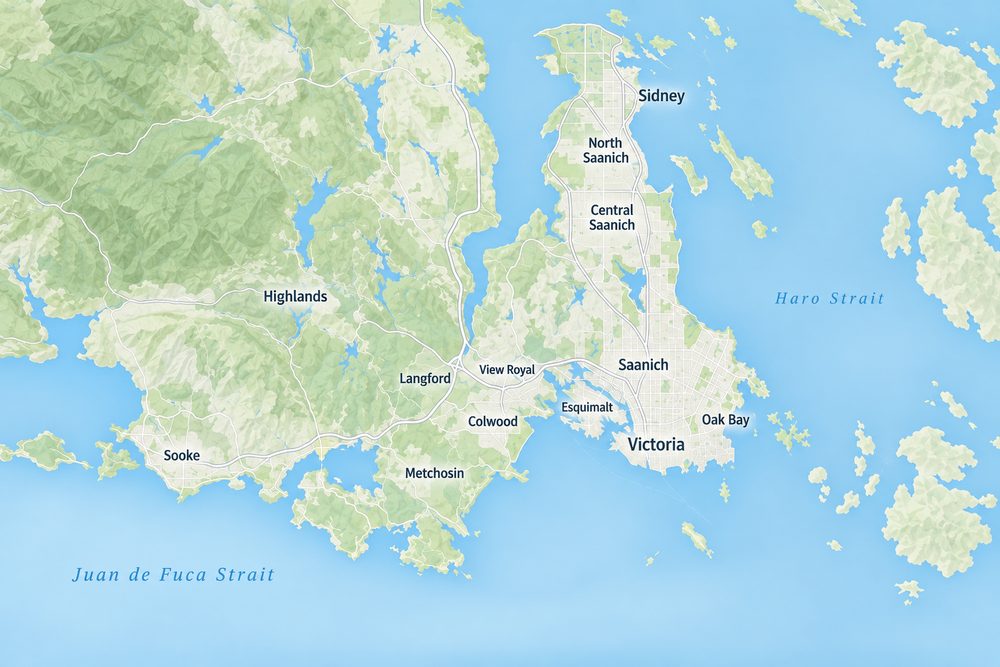
- Langford: long-standing parks including the 55+ Tri-Way park on Spencer Road, which opened in 1958, plus parks near Mill Hill and Florence Lake whose listings show age restrictions.
- View Royal: Glentana-area parks on Songhees land, where many 1990s multi-section homes on lanes such as Wolf Lane and Raven Court are in age-restricted parks.
- Central Saanich: leasehold communities on Tsawout land near Saanichton, from older parks on Central Saanich Road to homes built since 2010 off Tetayut Road.
- Sooke: several parks along Sooke River Road and in Saseenos, some 55+ and some open to all ages.
- Sidney: Summergate Village, a bare land strata of single-storey homes.
Living on a Fixed Income: Rent and Property Tax
For most buyers here, monthly costs matter as much as the price. In a park on municipal land, pad rent can rise only once every 12 months with three full months' notice, within a cap of 2.3% for 2026 plus a proportional share of higher local government levies and regulated utility fees. The 2027 cap is 2.2% plus the same share. A landlord can apply for more only for significant one-time repairs, extraordinary operating costs or the costs of financing a park purchase, and the increase must apply to every site equally.
Property tax on a park home is billed in the owner's name, and off reserve the provincial home owner grant can apply to a manufactured home that is assessed and taxed. On reserve land the First Nation collects the tax and the provincial grant does not apply, though Nations can offer their own programs. Tsawout's 2025 rates set a minimum tax of $100 for taxpayers 65 and over, and Songhees set a $100 minimum tax.
Tenancies, Leases and the Rules That Govern Them
Most 55+ parks on municipal land rent pads month to month. A fixed-term tenancy that does not require you to leave carries on month to month on the same terms when it ends. The landlord can end a tenancy only on set grounds and with set notice, such as 10 days for unpaid rent, which you can dispute within five days, or one month for cause, disputable within 10 days. The landlord cannot take a security deposit or a pet damage deposit for the pad. Park rules must be reasonable, and since April 30, 2024 a landlord without a park committee can change them only once a year, with three months' notice. Disputes go to the Residential Tenancy Branch.
None of this applies on reserve land, where the Residential Tenancy Branch has no jurisdiction. There, a registered sublease with a fixed term gives the most certainty, while a month-to-month arrangement may be ended on reasonable notice under the common law.
Selling, Estates and Passing a Home On
Under the Manufactured Home Park Tenancy Act, the word tenant includes the estate of a deceased tenant, and nothing in the Act ends a park tenancy on death. The executor or administrator becomes responsible for the rent and can sell the home where it sits, asking the landlord to consent to assigning the tenancy to the buyer under the same rules a living owner uses. The landlord must answer within 10 days, cannot charge a fee, and in a 55+ park can refuse only if no one moving in meets the age rule, or on another listed ground.
On reserve land, the lease decides whether and how an interest passes to an estate or family member, and what consents are needed. On Tsawout land, some family transfers are exempt from the Nation's property transfer tax. In every case, keep the paperwork together: the registry decal number, the CSA label details, the tenancy agreement or lease and, on reserve, a recent parcel abstract.
Downsizing From a House
Selling a house and buying a park home frees up equity, but the two transactions work differently. A home on a rented pad changes hands in the Manufactured Home Registry, and since property transfer tax is triggered by registration at a land title office, a registry-only purchase generally does not attract it. A used home bought for your own residence is exempt from PST. Plan for accessibility early: the home's label covers only the original unit, so a ramp, porch or addition needs approval from the local government off reserve and from the community everywhere.
Redevelopment and Older Residents
Older parks often sit on valuable land, and older residents have borne much of the uncertainty. At Tri-Way in Langford, residents learned in 2019 that the land was being sold. Council approved a rezoning in 2020 that shrank the park, and some owners reported long delays selling during the process. In 2025 the City of Langford bought Woodlands Park, letting tenants stay to January 31, 2030 and offering to buy homes at assessed value plus 10%. Off reserve, a landlord closing a park needs all required permits and must give 12 months' notice, with $20,000 for each tenant and the assessed value above that if the home cannot be moved. On reserve land those protections do not apply: when a park on Songhees land closed, the courts found that residents who believed they held 99-year leases were month-to-month tenants, and in 2026 the Court of Appeal confirmed that no compensation was owed.
Head Leases, Subleases and the Parcel Abstract
For a leasehold home on reserve land, the length of your interest is the key question at any age. Reserve land is held by the Crown for the band and cannot be sold. On designated land, a head lease is granted to a developer or operator, who subleases each lot, and your sublease can never run past the head lease. On Certificate of Possession land, a band member holds the allotment and grants the lease, permit or rental the home owner relies on. Tsawout and Songhees both manage their land under land codes and keep their own land registers. Indian Act reserves use the federal Indian Lands Registry. A parcel abstract shows the head lease, your sublease, any assignments and mortgages, and should be checked by a lawyer, because that registry does not guarantee title. Compare the years left on the head lease and sublease with how long you plan to stay, and with what your estate will need to sell.
Ownership and Financing for Retirees
Many 55+ buyers pay cash from the sale of a house, which removes the lender's questions but not the legal ones. On a rented pad you own only the home. On designated reserve land you hold a sublease under a head lease that a lender can mortgage only if it is registered and long enough, with a mortgage acknowledgement agreement in place. On Certificate of Possession land you deal with a band member landholder, and few lenders will finance. On a bare land strata lot you own the land outright. If you plan to borrow, confirm the lender's rules on the home's age and the years left on any lease before you remove conditions. The all manufactured homes page explains head leases, subleases and the parcel abstract in detail.
The Home: Certified, Safe and Easy to Live In
Most homes in 55+ parks are manufactured homes built to the CSA Z240 MH standard, either single-section or multi-section plans. A few newer homes are modular, certified under CSA A277. Park model trailers built to CSA Z241 are recreational units outside the Manufactured Home Act, so confirm that one can be lived in year round. A used manufactured home can be sold only if it carries an approval label, and Technical Safety BC can apply a silver label if it is missing. Homes built after May 15, 1992 must have met the CSA standard when built, and the BC Financial Services Authority notes that registry numbers starting with A, B or Z often mean a home built before April 1, 1978.
In older homes, check for aluminum wiring, common from the mid-1960s to the late 1970s, and Poly-B plumbing, used from about 1978 to 1997, both of which can affect insurance. Look at bathroom layouts, door widths, lighting and the steps up to the entry with your long-term needs in mind.
Questions to Ask a 55+ Community Before You Buy
- Where is the age rule written, and does it require one resident or every resident to be 55 or older?
- Can a younger spouse, partner or caregiver stay if the qualifying resident dies or moves to care?
- What is the current pad rent or lease rent, when did it last change, and how will it change?
- Are there rules on guests, pets, home additions, landscaping or renting the home out?
- Is the land for sale, rezoned or under a lease that ends within your planning horizon?
55+ Manufactured Home Questions
Can my younger spouse live with me in a 55+ park?
Generally yes. The Human Rights Code exemption that allows 55+ parks covers households where at least one resident has reached 55, so confirm the tenancy agreement says the same. In a strata, younger spouses and partners are among the exempt classes. On reserve land, check the lease and community rules.
What happens to my park home when I die?
The tenancy passes to your estate, which can pay the rent and sell the home in place through an assignment. A will and organized paperwork make that much easier for your executor.
Can an adult child move in to help care for me?
Live-in caregivers and, since 2023, adult children are exempt from strata age bylaws. In a park, ask the landlord in writing, and on reserve land check the lease.
General Information, Not Legal Advice
Age rules, leases and tax programs change. Have a lawyer or notary review the agreement, the age rule and the registry searches, and talk to your executor about the home, before you buy.