Published November 2026. Legislation, permit process and the status of the Heritage Conservation Act review checked November 15, 2026.
Greater Victoria has been continuously occupied for thousands of years, and the law reflects it. Under British Columbia's Heritage Conservation Act, archaeological sites that predate 1846 are automatically protected whether or not anyone has ever recorded them, and whether the land is Crown or private. There is no notation on your title, no line in the Property Disclosure Statement, and no warning when you buy. Dig into a protected site without a permit and you are breaking the law; find something mid-project and the work stops. Here is how likely that is here, how to check before you buy, and what it costs when it happens.
In this guide
What the law actually protects
The Heritage Conservation Act (HCA) is administered by the province's Archaeology Branch. Its central rule is short: you must not damage, excavate, dig in, alter or remove anything from a protected archaeological site except as authorized by a permit. The protection is automatic, and three features of it surprise most owners.
No designation needed
- Sites that predate 1846 are protected by the Act itself.
- No one has to list, designate or register them for the protection to apply.
- Burial places with historical or archaeological value are protected as well.
Ownership is irrelevant
- The Act applies on private property exactly as it does on Crown land.
- Owning the land does not give you the right to disturb what is in it.
- Your municipal building permit is not permission under the HCA.
Unknown sites count
- Protection does not depend on the site being in the provincial inventory.
- A site nobody has ever recorded is as protected as a famous one.
- "I checked and nothing was listed" is not a defence, though it helps show good faith.
Penalties are real. The Act provides for fines of up to $50,000 and up to two years' imprisonment for an individual, with substantially higher maximum fines for corporations, and the Province can order work stopped. A 2019 amendment also created a duty to report discoveries of sites and objects with potential heritage value.
How likely is this in Greater Victoria
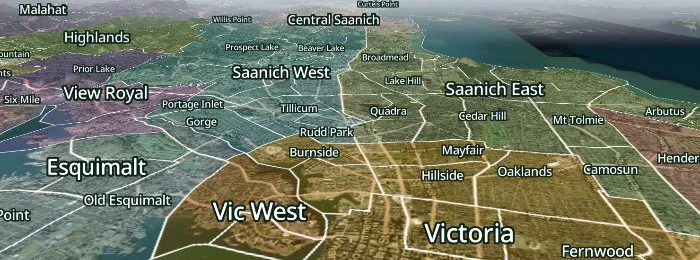
Likelier than almost anywhere else in the province. This is the territory of the Lekwungen-speaking peoples, today the Songhees and Esquimalt Nations, and of the WSANEC communities on the Peninsula, with Scia'new, T'Sou-ke, Malahat and Pacheedaht to the west and north. Village sites, shell middens, burial cairns and resource-processing sites line the shorelines, the harbours, the Gorge and the lakes.
| Where the lot is | Why it matters | Practical risk |
|---|---|---|
| Within a few hundred metres of saltwater | Shell middens and village sites concentrate along the shore: Oak Bay, Cadboro Bay, Cordova Bay, Esquimalt Harbour, the Gorge, James Bay, Sidney and Brentwood | High Assume a records check is needed before any excavation |
| Rocky knolls and bluffs near the sea | Burial cairn and mound complexes, particularly in Oak Bay, the Uplands and parts of Saanich | High These are also the sites where finds are most sensitive |
| Beside a lake, stream or estuary | Fishing and processing sites, trails and camps | Moderate Worth a records check for anything beyond minor landscaping |
| Downtown and the Inner Harbour | Pre-contact occupation plus historic-period deposits from the 1840s onward | Moderate Common on redevelopment and servicing projects |
| Inland suburban subdivisions | Lower density of recorded sites, but trails, camps and unrecorded sites exist | Lower Still check before major excavation |
The local record is not theoretical. In 2009 a construction project in Saanich near Cadboro Bay was halted when skeletal remains later described by the Royal BC Museum as at least a thousand years old surfaced on a vacant residential lot, prompting a police investigation into whether the HCA had been breached. In 2023, development work in Cordova Bay uncovered human remains from an ancestral burial site. In Oak Bay, a property on York Place made the news in part because it contained a midden. The Uplands, laid out over a landscape of burial cairns, is the best-known example of a neighbourhood where routine renovation carries this question with it.
What triggers the problem
Any land-altering activity inside a protected site needs authorization. In residential practice, the usual triggers are:
- Excavating for a new house, an addition, a garage or a basement
- A pool, pond, hot tub pad or large retaining wall
- New septic fields, wells, drainage or utility trenching
- Driveway construction, regrading or substantial landscaping
- Tree removal where stumps and roots are pulled
- Subdivision, where the approving authority may require assessment as a condition
- Demolition, where the slab or foundation comes out
Note the pattern: it is the ground disturbance, not the building, that matters. Painting a heritage house is irrelevant to the HCA; digging a trench across the yard is not.
The permits and the process
- Records check. Find out whether a recorded site touches the property, and whether the area is known for high potential. This is the cheap step, and it is the one most often skipped.
- Overview or preliminary assessment. Where the records are ambiguous, an archaeologist can review the setting and recommend whether field work is needed.
- Heritage inspection permit, section 12.2. Held by a qualified archaeologist, it allows subsurface testing to determine whether a site is present and how your project would affect it. The field study is an archaeological impact assessment (AIA).
- Design around it, if you can. If the assessment shows the work can proceed without affecting the site, no alteration permit is needed. Re-siting a house, shifting a driveway or redesigning a foundation is almost always cheaper than excavating a site.
- Alteration permit, section 12.4. Where impact cannot be avoided, this permit authorizes it, usually with conditions: archaeological monitoring, hand excavation, data recovery, and reporting afterwards.
- Do the work under the conditions, then file the reports the permit requires.
First Nations are consulted by the Province during the permit process. The Archaeology Branch charges no fee for HCA permits, but warns that some permit applications can take over 200 days to process, and industry groups have told the Province that assessments and permits can add up to a year to a project. Applications also bunch up between January and May.
What it costs, and who pays
The Province's position is that the owner or developer pays for the archaeological work done under a permit. What that amounts to depends entirely on what is found, which is why any quote should break out planning, field work, analysis and reporting, and state what the archaeologist is assuming.
The Oak Bay case that changed the question
- An Oak Bay owner near Willows Beach was required to deal with archaeology before building. The heritage inspection cost close to $6,000; it showed excavation would be required, and that work came to $51,000.
- Including construction delays, lost property value and legal fees, she put her total cost at roughly $750,000, and sued.
- In 2013 the BC Supreme Court found the Archaeology Branch had acted improperly in requiring her to pay for the archaeological research, and in 2014 the Province abandoned its appeal.
- As the BC Real Estate Association summarised it, the homeowner established that the Branch could not require her to pay for a heritage inspection and investigation as a precondition of getting a site alteration permit, since it was unfair for one owner to bear more than a fair share of the cost of a public benefit without a ministerial order.
- In practice, owners still pay for most assessments, and most do not have the resources to litigate. Treat this as a reason to get legal advice early, not as an assurance that someone else will pay.
The sensible planning assumption for a Greater Victoria waterfront or near-shore lot is that a records check costs little, an assessment with field testing runs into the thousands, and excavation and monitoring can run into the tens of thousands, with the schedule, not the invoice, often doing the most damage to a project's budget.
How to check a property before you buy or dig
- Submit an Archaeological Information Request. The Province's online form at archdatarequest.nrs.gov.bc.ca accepts requests from private property owners and from prospective purchasers and their agents, for information specific to that property. If you are not affiliated with a company or institution, enter "public" as your affiliation.
- Ask the municipality. Local government staff can access the provincial database (Remote Access to Archaeological Data, or RAAD) and many will tell you whether a recorded site touches a parcel, or will send a property owner notification letter when you apply for a permit.
- Hire a professional for a faster answer. RAAD itself is closed to the general public. Consulting archaeologists have access, and the BC Association of Professional Archaeologists will perform expedited data requests for a fee.
- Read the title anyway for designated heritage property and heritage covenants, which do register.
- Look at the setting. Distance to the shoreline, elevation above the beach, a freshwater source, and a south or east aspect are the classic indicators archaeologists use for potential.
Signs on the ground
Shell midden
Dark, greasy-looking soil flecked or packed with crushed and whole shell, often visible in a garden bed, a cut bank, a road cut or the spoil from a service trench. Fire-cracked rock and bone fragments turn up in it.
Burial cairns and mounds
Deliberate piles or rings of rock, sometimes on knolls and bluffs, sometimes landscaped into lawns and rockeries over the past century.
Stone tools and flakes
Chipped stone flakes, ground slate, hammerstones and net weights, often noticed first by whoever is digging a flower bed.
Historic-period material
Brick, hand-blown bottle glass, nails, privy pits and building foundations. Protection depends on age and designation, but the Branch still wants to hear about finds.
If you find something
Stop work immediately
At onceStop the machines in that area and protect the spot from further disturbance. Do not collect, clean, move or photograph artifacts for removal, and keep the location quiet to avoid looting.
Call the Archaeology Branch
Same dayReport the find. The Branch will advise what is required, which usually means engaging a qualified archaeologist and applying for the appropriate permit.
If the find looks like human remains, call the police
ImmediatelyPolice and the coroner determine whether remains are recent or ancestral, and the Archaeology Branch and the First Nation become involved. This is not a step to handle informally.
Expect a permit before you resume
Weeks to monthsResuming ground disturbance in a protected site without authorization is an offence, and the Act is enforced.
Build the result into the plan
AfterRe-siting, capping, or redesigning foundations often costs less than data recovery, and keeps the site intact. Keep the reports with your property file.
What this means when you buy or sell
Buyers
- If the lot is near the water, on a knoll, or anywhere you intend to excavate, run a records check during the subject period, not after completion.
- Where you are buying for a project, make the offer subject to your satisfactory review of archaeological information, and allow time to get a professional opinion.
- Price in the possibility of delay. On a build, a season lost is usually worth more than the assessment fee.
- Ask the seller what they know, and what was done the last time the ground was opened.
Sellers
- Disclose what you know. Known sites, heritage designations and past permits should be on the table, and a buyer who finds out later has a grievance.
- If you hold past assessments or permits, hand them over. They are an asset: they tell the next owner what is there and what was approved.
- Where a lot's value rests on its development potential, an existing records check or assessment makes that value credible.
Builders and investors
- Do the records check before you remove subjects on a development lot, and again before you set a construction schedule.
- Build archaeological contingency into pro formas on shoreline sites: the Province's own guidance warns of 200-day-plus permit processing.
- Design to avoid impact where possible. Avoidance is both cheaper and what the Branch prefers.
The law is being rewritten
The HCA has not been substantially overhauled since 1996, and the province's Heritage Conservation Act Transformation Project has been working toward amendments since 2021. Legislation expected in spring 2026 was postponed in January 2026 for further engagement, a Phase 3 technical policy paper was published on March 26, 2026, and amendments were anticipated to be tabled in the fall of 2026.
Two proposals matter most to property owners. One would require local governments and subdivision approving authorities to confirm that a heritage information check has been completed before issuing permits or approvals involving ground disturbance, which would push the records check to the front of the process where it belongs. The other would replace the current multi-permit structure with a simpler project-based permit. The proposals have drawn support and objection from different directions, and nothing is final. Check the Province's project website for the current status before relying on any of it.
Questions and answers
Does an archaeological site show up on title?
No. Automatic protection under the Heritage Conservation Act does not register on title. Designated heritage property and heritage covenants do register, so a title search is still worth doing, but a clean title tells you nothing about unrecorded or unregistered archaeological deposits.
Can I find out for free whether my property has a recorded site?
Yes. Submit the Province's online Archaeological Information Request, which accepts requests from private property owners and from prospective purchasers and their agents about a specific property. Many municipalities will also check their records for you. The full RAAD database is restricted to authorized users such as archaeologists, First Nations and local governments.
What does a permit cost?
The Province charges nothing for a Heritage Conservation Act permit. The cost is the archaeologist's work: the assessment, any field testing, monitoring or excavation, the analysis and the reporting, all of which the property owner or developer is expected to pay for.
How long does it take?
The Archaeology Branch warns that some permit applications take over 200 days, and industry groups report that assessments and permits can add up to a year to a project. Applications pile up between January and May, so timing matters.
What happens if I just keep digging?
Altering a protected site without a permit is an offence under the Act, which provides for fines up to $50,000 and up to two years' imprisonment for an individual, with higher maximums for corporations, plus stop-work powers. Enforcement in Greater Victoria has included police investigations when remains were disturbed.
Can the Province stop me from building at all?
Usually the outcome is conditions rather than refusal: re-siting, capping the site, hand excavation, or monitoring during construction. Outright protection of a site against development has happened in BC, but it is rare and tends to involve burial sites of exceptional significance.
Is a home inspection or a survey going to catch this?
No. Neither looks for archaeological deposits. A home inspection covers the building; a survey covers boundaries. Archaeology is its own records check and, where warranted, its own professional study.
Does this affect ordinary gardening?
Light surface gardening is not the concern. Digging that disturbs buried deposits is, which is why a records check is sensible before a pool, a new drainage system, a retaining wall or anything that takes a machine into the ground on a high-potential lot.
Thinking about a waterfront or near-shore lot?
The records check belongs in the subject period, along with the title search and the environmental history.
Reading a BC title searchContaminated land in BCAsk a questionPhoto from Wikimedia Commons, used under the licence linked in the caption.