Published November 2026. Legislation, fees and processes checked November 15, 2026.
In British Columbia, the person who spilled something is not the only one who pays to clean it up. Under the Environmental Management Act, the current owner of contaminated land is a responsible person, and that liability is absolute, retroactive, and joint and separate: no fault is needed, it reaches back to contamination caused decades before the law existed, and any one responsible person can be pursued for the entire bill. Buy the wrong lot and you buy the cleanup. Here is how a site becomes contaminated, how to find out before you commit, who ends up paying, and what it costs.
In this guide
- What counts as a contaminated site
- Where contamination comes from here
- Who is responsible, and who is not
- Site disclosure statements
- How to check a property
- Determinations, AiPs and certificates
- What cleanup costs
- Consequences of owning one
- Moving soil off the site
- Protecting yourself in a deal
- Two local examples
- Questions and answers
What counts as a contaminated site in BC
The rules live in Part 4 of the Environmental Management Act (EMA) and in the Contaminated Sites Regulation (CSR). A site is contaminated when a substance is present at a concentration above the standards set in the regulation. Those standards are not one number: they depend on the substance, on the pathway by which people or wildlife could be exposed, and on the land use. Residential standards are stricter than commercial or industrial ones, which is why land that was perfectly legal as a machine shop can fail as a building lot.
Two consequences follow for ordinary buyers. First, a property can be contaminated without anything visible: no drums, no stained ground, no smell. Second, a property can pass as industrial land and fail the moment someone proposes houses on it, which is exactly the moment the issue tends to surface in Greater Victoria.
Where contamination comes from in Greater Victoria
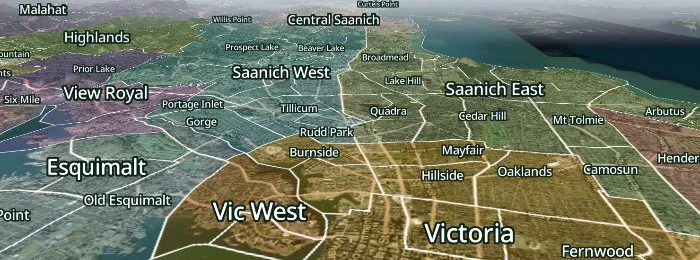
Schedule 2 of the CSR lists the industrial and commercial uses the province treats as worth a second look. Many of them have left traces on land that is residential today, particularly along the Upper Harbour, in Rock Bay, Vic West and Esquimalt, around the old rail corridor, and on the farmland of the Peninsula and Metchosin.
| Former use | What it tends to leave behind | Where it turns up |
|---|---|---|
| Service stations and bulk fuel | Petroleum hydrocarbons, benzene, lead from old gasoline, buried tanks and lines | Corner lots on arterial roads, now small commercial or mixed-use redevelopment |
| Dry cleaners | Chlorinated solvents such as PCE, which move through soil and groundwater and can produce vapours indoors | Older strip malls and mixed-use blocks with suites above |
| Auto repair, body shops, machine shops | Solvents, waste oil, metals, paint residues | Light industrial pockets near Rock Bay, Burnside and Esquimalt |
| Marine, boatyards and shipbuilding | Metals, tributyltin from antifouling paint, hydrocarbons, sandblast grit | The harbours and the Gorge, Esquimalt, Vic West |
| Gasworks, foundries, mills and rail | Coal tar, polycyclic aromatic hydrocarbons, heavy metals, creosote | Rock Bay and the Upper Harbour, where Victoria's heavy industry sat |
| Heating oil tanks | Furnace oil in soil, drains and groundwater | Any pre-1992 house. See our underground oil tank guide |
| Orchards and market gardens | Lead and arsenic residues from historic pesticides, and other persistent agricultural chemicals | Older farmland on the Saanich Peninsula and in the rural west |
| Imported fill of unknown origin | Anything that was in the soil where it came from, including metals and hydrocarbons | Levelled lots, raised yards and reclaimed shoreline anywhere |
| Old dumps, burn sites and shooting ranges | Metals, ash, lead shot, asbestos and buried waste | Rural acreages and land at the edge of older municipalities |
Who is responsible, and who is not
Section 45 of the EMA sets out who is a responsible person. The list is deliberately wide.
The current owner or operator
Ownership alone makes you responsible. You do not have to have caused anything.
Any previous owner or operator
Previous owners stay in the net, which is why a buyer who discovers contamination later can sometimes recover from them.
Producers and transporters of the substance
Those who produced the substance, or arranged for its transport or disposal, can be responsible too.
Owners of the site it migrated from
If a substance travels onto your land, the responsible persons for the source site are also responsible for your land.
Section 47 then sets the standard of liability. It is absolute, so no fault, negligence or wrongdoing has to be proved. It is retroactive, so it covers contamination that happened long before the EMA or its predecessors existed. And it is joint and separate, so each responsible person can be pursued for the full reasonably incurred cost of remediation, whether that cost is incurred on the site or off it. Anyone who pays for cleanup, including a buyer who finds a problem after closing, can sue other responsible persons to recover reasonable costs.
The exemptions that matter to a buyer
- Innocent acquisition. Section 46 excuses an owner or operator who can show the site was already contaminated when they acquired it, that they had no knowledge or reason to know, that they made all appropriate inquiries into previous ownership and uses before buying, and that they did not contribute to the contamination afterwards. The phrase "all appropriate inquiries" is doing the work: a buyer who skipped the homework usually cannot rely on it.
- Minor contributor. Section 50 lets a director determine that a responsible person contributed only a minor part, that little remediation is attributable to them, and that joint liability would be unduly harsh, and then fix their share.
- Other designated categories. The regulation also exempts certain lessors, transporters of contaminated soil, people who merely carried out construction on a site, and others in defined circumstances.
Site disclosure statements: what replaced the site profile
On February 1, 2021, BC replaced the old "site profile" system with the site disclosure statement. The owner or operator of a site, or their agent, completes it, and it goes to the provincial site registrar rather than sitting in a municipal file. A statement is required where the land has been used for a Schedule 2 industrial or commercial use and the person knows or reasonably should know about that use, unless an exemption in Division 3 of the regulation applies.
| Trigger | Who provides it | When |
|---|---|---|
| Selling the property | The vendor, to the prospective purchaser | Before the sale, where the vendor knows or ought to know of a Schedule 2 use |
| Zoning, subdivision, development or building permit involving soil disturbance | The applicant, to the municipality or approving officer | With the application |
| Decommissioning a site or ceasing operations | The owner or operator, to the registrar | Within 6 months |
| Insolvency, receivership or foreclosure | The person in control, in the defined circumstances | As set by the regulation |
The residential exemption, and why it should change how you write offers
- Section 4.6 of the regulation exempts a vendor from providing a site disclosure statement where the property is used primarily for residential purposes at the time of the contract, or has never been zoned for anything other than primarily residential use.
- In plain terms: on an ordinary house sale, nobody has to hand you anything, even if the lot was a garage in 1965.
- The Property Disclosure Statement asks the seller what they are aware of. A "no" means the seller is not aware, not that the ground is clean.
- If the property's history looks industrial or commercial, the protection has to come from your own subject clauses, not from a form.
How to check a property before you commit
- Look at the history, free. The province's iMapBC has an Environmental Remediation Sites layer that shows sites already in the system, and it costs nothing to search.
- Search the Site Registry. Searches through BC Registries and Online Services by PID, address, Site ID or area are free. A full Site Details Report is $150 plus a service charge and GST. First Nation governments and modern treaty nations get this information at no charge.
- Read the title. Environmental covenants under section 219 of the Land Title Act, and notices relating to remediation, register on title. Our guide to reading a BC title search covers what each charge means.
- Ask the municipality. Building and business licence files, fire department records and old permit cards show what operated on the lot. Several Greater Victoria municipalities sell a property information letter that pulls this together.
- Look at the old pictures. Historical air photos, fire insurance plans and city directories are the standard way an environmental professional reconstructs a site's past, and they are available through local archives and libraries.
- Commission a Phase I ESA. A non-intrusive records, interview and site-walk study under the CSA Z768 standard, written by a qualified professional. Published Canadian ranges run from roughly $2,500 to $8,000 for ordinary properties, more for large or complicated ones, and a Phase I is generally treated as current for about a year.
- Go to Phase II only if Phase I says to. A Phase II actually drills and samples under CSA Z769. Published ranges start around $10,000 to $25,000 for a small urban site and climb steeply from there.
Determinations, approvals in principle and certificates of compliance
Determination
- A director decides whether a site is a contaminated site under section 44.
- Can be requested, or made on the ministry's own initiative.
- Goes into the Site Registry, where lenders and buyers can see it.
Approval in principle
- The ministry signs off on a remediation plan before the work is done.
- Often what a developer needs to keep a project moving.
- Financial security can be a condition.
Certificate of compliance
- Issued once remediation meets the applicable standards.
- What lenders, insurers and buyers ask to see.
- A conditional certificate applies where some risk is managed rather than removed, and can come with a covenant on title.
Remediation can be numerical, meaning the contamination is removed or treated until concentrations meet the standards, or risk-based, meaning the contamination stays and the exposure pathways are cut off, for example with a cap, a barrier or restrictions on use. Risk-based remediation is cheaper and faster, and it is also why a certificate can come with a covenant registered on title that limits what you may do with the land, including digging in certain areas. Read the covenant before you plan a basement or a garden.
Applications to the ministry carry fees in the thousands of dollars, and the ministry publishes its current fee schedule in the Contaminated Sites Regulation and its fee-update guidance. Budget for the consultant's time as the larger cost in almost every case.
What cleanup costs, and how long it takes
There is no useful average: the number is driven by how much soil has to move, where it has to go, whether groundwater is involved, and whether anything sits under a building. The pattern, though, is consistent.
| Situation | Typical work | Scale of cost |
|---|---|---|
| Clean Phase I, no further action | Records review, site visit, report | Low thousands |
| Limited hot spot in a yard | Excavation, disposal at an authorized facility, confirmation sampling | Tens of thousands |
| Groundwater or vapour involved | Monitoring wells, treatment or vapour mitigation, years of monitoring | Hundreds of thousands |
| Former industrial parcel going residential | Full investigation, large-scale soil removal, risk assessment, certificate | Millions |
Phase I
WeeksRecords, interviews and a site walk. This is the step that fits inside a normal subject period, if you start it early.
Phase II
Weeks to monthsDrilling, sampling and laboratory turnaround. This rarely fits a two-week subject period, which is the single most common scheduling mistake.
Remediation plan and approvals
MonthsPlan, ministry review where an approval in principle is sought, contractor procurement.
The work
Weeks to yearsExcavation and disposal are quick; groundwater treatment and monitoring are not.
Certificate of compliance
After confirmation samplingKeep it, with the lab results and disposal records, in the property file. It is what the next buyer will want.
What happens when you own a contaminated site
Financing stops
Lenders do not want security they could become responsible for. A registry entry, an order, or even an unresolved Phase I recommendation can end a mortgage approval, and refinancing later is no easier.
Insurance narrows
Standard property policies exclude gradual pollution. Specialist environmental cover exists, is underwritten on the specific site, and is priced accordingly.
Permits stall
Zoning, subdivision and soil-disturbing permits trigger the disclosure process, and an application can be held while the province deals with the site. Development timelines slip by seasons, not weeks.
Orders and lawsuits
A director can order investigation or remediation. Anyone who spends money cleaning up, including a neighbour whose land was affected by migration, can sue responsible persons to recover reasonable costs.
Resale becomes slow
A listed site attracts buyers who price in the worst case. Stigma can outlast the cleanup, which is why a certificate of compliance is worth paying for even when a risk-based approach would satisfy the regulator.
Your plans shrink
Where risk was managed rather than removed, a covenant can bar excavation, limit landscaping or rule out residential use of part of the lot. That is a permanent change to what the land is worth.
If you are moving soil off the property
Since March 1, 2023, BC regulates the relocation of soil, not just contaminated soil. The old contaminated soil relocation agreements are gone. In their place, soil is tested, and in most cases a Soil Relocation Notification Form goes to the ministry at least one week before the soil moves, with notice also given to affected local governments and Indigenous nations. Receiving sites that take more than 20,000 cubic metres over their lifetime are treated as high-volume sites with extra requirements, and administrative penalties apply for non-compliance.
Protecting yourself in a purchase
If you are buying
- Ask about the site's history before you write. What was here, what is next door, and what is uphill and upstream of it.
- Make the offer subject to your satisfactory review of an environmental investigation, and give it a realistic number of days. A Phase II does not fit in a week.
- Ask for everything the seller has: prior Phase I or Phase II reports, site disclosure statements, any determination, approval in principle, certificate of compliance, orders, and covenants.
- Say who pays for what in writing. Who investigates, who pays to remediate, whether the cost is capped, and what happens if the estimate goes over the cap.
- Consider a holdback in trust rather than a promise to deal with it later, and make the release conditions explicit.
- Treat an indemnity as a backstop, not a shield. A private indemnity does not stop the ministry from naming you as a responsible person; it only gives you a claim against someone else, and only for as long as they are solvent.
- Keep the file. Your inquiries are evidence for the innocent-acquisition exemption, and the next buyer will want them.
If you are selling
- Find out your own site's history before you list, not during somebody's subject period.
- Answer the Property Disclosure Statement accurately, and attach what you have. Concealing a known problem invites a misrepresentation claim.
- If a Schedule 2 use happened on the land, ask a lawyer whether a site disclosure statement is required and whether an exemption applies.
- Where a cleanup is already done, assemble the certificate, lab results and disposal records. Documented history sells; uncertainty discounts.
Two local examples
Rock Bay
A coal gasification plant operated at Rock Bay from 1862 until the early 1950s, leaving coal tar and metals in soil, groundwater and harbour sediment, and the site became known as one of the most contaminated in the province. Remediation by BC Hydro and Transport Canada ran from 2004 to 2016 and moved roughly 250,000 tonnes of soil and sediment, including draining part of the bay behind a cofferdam. The Times Colonist put the bill at $138 million as the work neared its end; CBC reported nearly $150 million on completion. The remediated land was destined for the Songhees and Esquimalt Nations.
Dockside Green
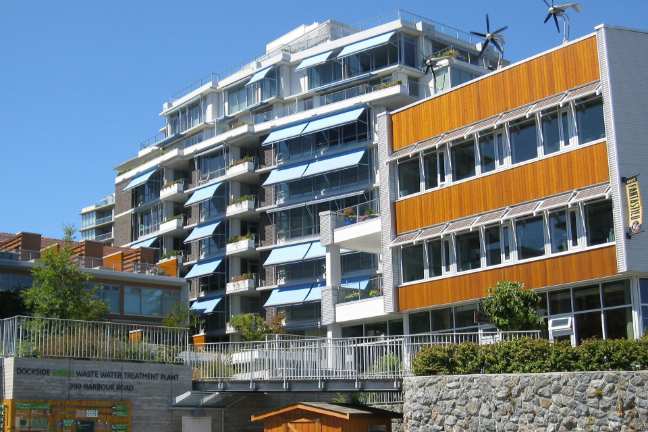
Fifteen acres of former industrial waterfront, so encumbered by environmental liability that the province transferred the land to the City of Victoria for $1. The city remediated it, at a cost reported at about $12 million, and sold it for development in 2005 under a master development agreement. It is now one of the better-known addresses in Vic West, which is the useful part of the story: contaminated land is not worthless land, but someone pays for the cleanup first, and the price of the dirt reflects it.
Questions and answers
I did not cause the contamination. Why am I responsible?
Because under section 45 of the Environmental Management Act a current owner is a responsible person regardless of fault, and section 47 makes that liability absolute, retroactive, and joint and separate. The main escape route for a buyer is the innocent-acquisition exemption, which requires showing you had no knowledge or reason to know and that you made all appropriate inquiries before buying.
Does the seller of a house have to tell me the lot was once a gas station?
A vendor of a property used primarily for residential purposes is exempt from providing a site disclosure statement under section 4.6 of the Contaminated Sites Regulation. The Property Disclosure Statement only asks what the seller is actually aware of. On a lot with a commercial or industrial past, the checking is yours to do.
How do I find out whether a property is on the provincial registry?
Search the Site Registry through BC Registries and Online Services by PID, address or area, which is free, and order a Site Details Report for $150 plus a service charge and GST if anything comes up. The free Environmental Remediation Sites layer in iMapBC is a quick first look.
Is a certificate of compliance the same as clean?
Not necessarily. A certificate confirms the site meets the applicable standards for its use, which may have been achieved by managing risk rather than removing contamination. Read the certificate, the land use it is based on, and any covenant registered on title before assuming you can dig.
Can I recover the cleanup cost from a previous owner?
Possibly. Anyone who incurs reasonable costs of remediation may bring a cost-recovery action against responsible persons, which includes previous owners and operators. How much you recover depends on the facts and on who is still solvent, so see a lawyer with contaminated sites experience early.
Does a home inspection cover this?
No. A home inspection is a visual review of the building, not a soil investigation. See our home inspection guide for what one does cover, and treat environmental work as a separate scope with a separate professional.
What about an old oil tank? Is that a contaminated site?
It becomes one if the oil reached the soil or groundwater above the standards. The liability rules in this article are exactly the ones that apply, and the practical steps, permits and municipal rules are in our underground oil tank guide.
Is contaminated land ever a good buy?
It can be, if the cost of the cleanup is known rather than guessed and the price reflects it, which is how most brownfield redevelopment works. The risk is not contamination; it is buying an unquantified liability. That is why investigation comes before price negotiation, not after.
Buying land with a past in Greater Victoria?
Know what the history is before you remove subjects, and how to write conditions that actually protect you.
Underground oil tanksWriting an offer in BCAsk a questionPhoto from Wikimedia Commons, used under the licence linked in the caption.