


Updated October 30, 2026 with the current BCFSA, BC Housing, CRA and BC tax rules.
A presale lets you lock in a brand-new condo or townhome in Greater Victoria at today's price, often years before you get the keys. In return you take on risks a resale buyer never faces: delays, design changes, a lender's appraisal at completion, and a contract written by the developer. BC law gives you real protections, including a 7-day right to cancel, trust-held deposits and the 2-5-10 home warranty. This guide explains how each one works as of October 2026, what the taxes and rebates are worth, and the questions to ask before you sign.
In this guide
- How a presale works
- Disclosure and your 7-day right
- Deposits and how they are protected
- Completion dates, delays and changes
- Financing and appraisal risk
- Pre-delivery inspection
- The 2-5-10 home warranty
- GST, rebates and transfer tax
- Assignments
- Builder or assignor?
- Presales in Greater Victoria
- Questions to ask the developer
- Presale checklist
- Questions buyers ask
How a presale works, start to finish
A presale is a contract to buy a strata lot that has not been built, or not finished. Most multi-unit presales in BC are governed by the Real Estate Development Marketing Act (REDMA), which BCFSA administers, and by the Strata Property Act once the strata is created. The new home itself is covered by the Homeowner Protection Act and its warranty rules, which BC Housing administers. Here is the usual sequence.
Disclosure statement and marketing
Before you signThe developer files a disclosure statement with the Superintendent of Real Estate before marketing. Under BCFSA policy it may market before it has a building permit and construction financing, but must file an amendment showing both within 12 months, or 18 months for large projects in a BCFSA pilot.
You sign; the 7-day clock starts
7 daysYou receive the disclosure statement, sign an acknowledgment and sign the purchase agreement. You can cancel in writing within 7 days of the later of the two.
Deposits
At signing and on the contract scheduleDeposits go into trust with a brokerage, lawyer or notary, and are paid in stages if the contract says so.
Construction and amendments
Months to yearsThe developer must amend the disclosure statement when material facts change and send the amendments to buyers.
Notice of completion
Per your contractWhen the occupancy permit is issued and the strata plan is deposited, the developer notifies you that the unit is ready and sets the completion date.
Pre-delivery inspection
Before completionYou walk through the unit and record deficiencies in writing.
Completion and possession
Completion dayYou pay the balance, title transfers and your unit's warranty coverage starts.
First annual general meeting
Within 6 weeks of the triggerThe developer must hold it within six weeks after the earlier of 50% plus one of the lots being sold or nine months after the first sale, and hand over plans, warranties and records.
The disclosure statement and your 7-day right
What the developer must disclose
REDMA generally applies to developments of five or more units. Before marketing, the developer must file a disclosure statement that plainly discloses all material facts without misrepresentation. Before you sign, it must give you a copy, allow you a reasonable opportunity to read it, and get your signed receipt. Since April 1, 2025, new disclosure statements must open with BCFSA's "Summary of Pre-sale Risks and Buyer Rights", a short form you initial that points to the sections that matter most. BCFSA's consumer guide highlights the estimated construction dates (section 5.1), the estimated strata fees (3.8), the proposed bylaws (3.5), parking (3.6) and your rights and obligations (7.2).
Disclosure does not stop when you sign. If the statement becomes inaccurate or misleading, the developer must promptly file an amendment, deliver it to buyers, and stop marketing until it does. In 2026 the BC Supreme Court showed how seriously courts take this: in a case about the Lumina Eclipse project in Burnaby (2026 BCSC 1598), it declared 39 presale contracts unenforceable against the buyers because the developer had not amended its disclosure statement to reveal a stop-work, a suspended building permit, suspended warranty coverage and other problems. If a filed statement contains a misrepresentation, buyers can also sue for damages, generally within two years of learning of it.
The 7-day rescission right
- How long: 7 days after the later of the date you signed the purchase agreement and the date you gave the developer your written acknowledgment that you had a chance to read the disclosure statement.
- How: written notice served on the developer. Follow the method set out in the disclosure statement and keep proof of delivery.
- Cost: none. The deposit holder must promptly return your deposit.
- No statement, no deadline: if the developer never gave you a required disclosure statement, you can generally rescind at any time, subject to limited exceptions.
- Not for assignees: someone who takes over a contract by assignment does not get the 7-day right.
Small projects are different. Duplexes, triplexes and fourplexes built under BC's newer small-scale multi-unit housing rules can be sold before completion without a REDMA disclosure statement, and so without the 7-day right. If you are buying in a project of fewer than five units, ask your lawyer what protection the contract gives you, and read our guide to suites and Bill 44 zoning in Victoria.
The developer's other obligations
Interim budget
You must get the 12-month interim budget before you sign. If actual expenses exceed it, the developer pays the shortfall within 8 weeks after the first AGM, plus an extra amount if the overrun is 10% or more.
Reserve fund
The developer funds the contingency reserve fund at the first sale. If that sale is more than a year after the plan is deposited, the minimum is the lesser of 10% of estimated operating expenses for each year since deposit and 50%.
First AGM and handover
At the first AGM the developer hands over building permit plans, the strata plan, contracts, the disclosure statement, warranties, manuals and contractor lists.
Reports for the new strata
A strata created from July 1, 2024 needs a depreciation report within two years of its first AGM (18 months for stratas created from July 1, 2027, when developers also start funding it), and an electrical planning report within five years of the plan's deposit.
Deposits and how they are protected
REDMA does not set a deposit amount; your contract does. Deposits are commonly paid in instalments: one on signing and more on fixed dates or construction milestones. Whatever the schedule, the developer must promptly place every deposit with a brokerage, lawyer or notary, who holds it in trust in a BC savings institution for both you and the developer. It can be released only in limited cases, such as completion, your written consent, a court order or your default.
| Illustrative example: $650,000 presale condo | Amount | Running total |
|---|---|---|
| 5% deposit on signing | $32,500 | $32,500 |
| Second 5% deposit, 60 days later | $32,500 | $65,000 |
| Third 5% deposit, 12 months after signing | $32,500 | $97,500 |
| Balance due on completion (mortgage plus cash) | $552,500 | $650,000 |
The figures are hypothetical; every developer sets its own schedule. Before you sign, make sure you can pay every instalment on time, because missing one can put you in default.
Deposit protection insurance
A developer that wants to use your deposits for construction or marketing, instead of leaving them in trust, must first buy a deposit protection contract from an insurer and give you the required notice. The trustee releases the money only after receiving that contract and the developer's certification that your rescission period has passed. If the developer then fails to complete, the insurance stands behind the deposits that were released. Ask whether your deposits will stay in trust or be released under deposit insurance, and who the insurer is.
If the project is cancelled, BCFSA's consumer guide says the developer must return your deposit, but is not required to compensate you for anything else, such as the rise in prices while you waited. If you default, you can lose your deposit and be sued for the developer's losses on resale.
Completion dates, delays and changes
Estimated completion and outside dates
The disclosure statement gives an estimated completion window, but the date that matters is in your contract. Most contracts allow the developer to extend completion for delays beyond its control and set an outside date, sometimes called a sunset date, after which either side may end the contract and the deposit is returned. Courts have enforced these clauses as written. In 2025 the BC Court of Appeal (Anderson Square Holdings Ltd. v. Zhang, 2025 BCCA 288) overturned a $13.1 million award to presale buyers of a Richmond project, finding that the outside date was a "drop-dead date" that ended the contracts, not a promise to finish by that date. If prices have risen by then, a developer may be able to cancel and resell at today's prices. BCFSA's guide also warns that where construction runs past a contract date, a developer may offer the unit at a higher price, leaving you to pay more or cancel and take your deposit back.
Size, layout and finish changes
Contracts commonly let the developer change layouts, reduce floor area and substitute finishes of similar quality. Some contracts adjust the price or let you cancel if the area shrinks by more than a set percentage; many do not. Read the clauses on area, finishes, parking and storage, and ask whether your parking stall will be limited common property or a lease, because your rights differ.
Strata fees and occupancy
Strata fees in the disclosure statement are estimates, and fees, insurance and property tax usually rise over time. The balance of your price is due when the developer confirms the unit is ready to occupy. If your contract allows you to move in before title transfers, ask in writing what you will pay during that period and what rights you have if completion is delayed.
Financing and appraisal risk at completion
A mortgage pre-approval rarely lasts until a building is finished, so you will usually qualify again close to completion, at the rates and rules in force then and with your income at that time. The lender will also appraise the finished unit. If the appraisal comes in below your contract price, the lender lends against the lower figure and you make up the difference in cash.
Ways to reduce the risk: keep a cash buffer, ask your lender about rate holds and how long they last, avoid taking on new debt or changing jobs before completion, and confirm the lender will finance this building type. Our guide to mortgage financing in Victoria covers qualification and the stress test.
The pre-delivery inspection and deficiencies
Before completion, developers normally invite each buyer to a pre-delivery inspection (PDI) walk-through. It is your chance to record visible defects and unfinished work while the developer still wants your money. Take it seriously.
- Bring help and tools. Consider hiring a home inspector who does new-construction inspections; bring a phone charger to test outlets, a flashlight and a copy of your contract's finish schedule.
- Test everything. Run every tap, flush toilets, run appliances, open and lock every window and door, check the balcony door seals, the floors, the drywall and the caulking.
- Get it in writing. Make sure every item is on the signed PDI form, with photos. Keep a copy.
- Agree on timing. Ask when listed deficiencies will be fixed and how you will be told.
- Keep watching after you move in. Many problems appear only in the first heating season or the first heavy rain. Report them in writing as described below.
Problems with the common property, such as the roof, lobby or parkade, belong to the strata corporation, which has its own 15-month materials and labour coverage. Encourage your new council to commission a warranty review before key warranty periods end.
The 2-5-10 home warranty
Under the Homeowner Protection Act, new homes built by licensed residential builders must carry third-party home warranty insurance from an approved provider. The regulation sets these minimums:
| Coverage | Minimum length | What it covers |
|---|---|---|
| Materials and labour | 12 months (unit); 15 months (strata common property) | Any defect in materials and labour, and building code violations that pose an unreasonable health or safety risk or cause material damage |
| Delivery and distribution systems, exterior details | 24 months | Defects in electrical, plumbing, heating, ventilation and air conditioning distribution systems; in exterior cladding, caulking, windows and doors that could cause detachment or material damage; and defects that make the home unfit to live in |
| Building envelope | 5 years | Defects in the envelope, including water penetration that causes or is likely to cause material damage |
| Structure | 10 years | Structural defects |
Limits, deductibles and exclusions
Providers may cap claims, but not below these amounts: for a strata unit, the lesser of the original purchase price and $100,000; for a detached (fee simple) home, the lesser of the price and $200,000; and for common property, the least of the total original purchase price, $100,000 times the number of units, and $2.5 million per building. A provider cannot charge you a deductible for covered repairs or make you sign a release first. If a covered defect makes your home uninhabitable, reasonable living-out expenses are covered, and any daily cap must be at least $100.
Providers may exclude, among other things, normal wear and tear and shrinkage, damage from poor maintenance or your own alterations, landscaping, detached non-residential structures, and losses you failed to mitigate or report promptly. They cannot exclude recreational or amenity facilities in common property, or parking structures in multi-unit buildings.
When coverage starts and who it covers
For a strata unit, coverage starts on the earlier of the date you first occupy it and the date title transfers. Common property coverage starts on the first such date for any unit in the building, so it can begin well before you move in. The warranty stays with the home when it is resold, until it expires.
Making a claim
- Find your documents. Your warranty certificate names the provider and the policy number; keep it with your purchase documents.
- Give written notice. Notify both the warranty provider and the builder in writing, with reasonable detail, within a reasonable time after you discover the defect and before the coverage expires. Written notice to the provider also satisfies your duty to mitigate.
- Limit the damage. If a defect needs immediate attention, such as an active leak, take reasonable steps to stop it from getting worse and keep receipts.
- Let the provider investigate. Providers must contact you promptly, avoid unreasonable delay and give written reasons if they deny a claim.
- Escalate if needed. Policies include a dispute process; ask BC Housing or a lawyer if you reach an impasse.
Check the builder and the home
BC Housing's New Homes Registry, searchable by address or legal description, shows whether a home has home warranty insurance or was built under an exemption. Use it before you sign for any new or nearly new home, and ask the developer to confirm in writing that the builder is licensed and the units are enrolled.
Owner-built homes are the main exemption. An owner-builder must get an Owner Builder Authorization from BC Housing, must live in the home for the first year and cannot sell or rent it during that time. If the home is sold within ten years, the seller must give the buyer an Owner Builder Disclosure Notice before the contract is signed, and every later seller in that period must pass it on. An owner-built home usually has no third-party warranty, so price that risk in.
GST, rebates and property transfer tax
New homes in BC carry 5% GST, usually on top of the price unless the contract says otherwise. There is no provincial sales tax on the purchase of real property. Three programs can reduce your costs.
GST new housing rebate
36% of the GST on a home priced at $350,000 or less, phasing out to nothing at $450,000. Few Greater Victoria new homes are priced low enough to qualify.
First-time home buyers' GST rebate
All of the GST on a new home up to $1 million, phasing out to nothing at $1.5 million. The agreement with the builder must be signed on or after March 20, 2025 and before 2031, construction must start before 2031, and the home must be completed and transferred before 2036.
Newly built home exemption
No property transfer tax on a newly built principal residence with a fair market value up to $1,100,000, and a partial exemption up to $1,150,000. You must move in within 92 days and live there for the first year.
For the first-time buyers' rebate, you must be at least 18, a Canadian citizen or permanent resident, and must not have lived in a home owned by you or your spouse or common-law partner in the year of purchase or the four calendar years before it. You must also be the first person to live in the home after it is built, and neither you nor your partner can have received the rebate before. Commentary on the rebate indicates that assigning a builder agreement signed before the cut-off date does not create eligibility, so if you are buying an assignment, confirm with your lawyer or accountant whether the rebate is available.
The PTT exemption applies only to the first registration of a newly built home with a completed improvement, on land of 0.5 hectares or less for the full exemption. Our page on BC real estate transaction taxes covers the transfer tax rates, the first-time buyers' program and the other taxes that can apply.
Assignments
An assignment transfers your rights and obligations under a presale contract to someone else before completion, usually for your deposit back plus a profit, or sometimes at a loss.
Developer consent and reporting
If a developer permits assignments, its purchase agreements must prohibit assignment without the developer's prior consent. Before consenting, the developer must collect information about both parties and the price, and report every assignment to the province's Condo and Strata Assignment Integrity Register (CSAIR), which has applied to assignments signed since January 1, 2019. Many contracts also charge an assignment fee, and a developer can refuse consent even if you have a buyer. If your assignee fails to complete, you typically remain liable to the developer.
Taxes on an assignment
- GST on the assignment. Since May 7, 2022, every assignment of a contract for a newly built home is taxable for GST. The assignor collects GST on the assignment price; the part that reimburses deposits paid to the builder is excluded only if the assignment agreement says so in writing.
- BC home flipping tax. From January 1, 2025, the assignor's profit is taxed at 20% if the contract is assigned within 365 days of acquiring it, at a declining rate up to day 730, and not at all after that. Presale assignors cannot use the principal residence deduction, though an exemption exists where completion was delayed more than 365 days. A separate return is due within 90 days of the sale.
- Income tax. The profit is also reportable for federal income tax, and a short holding period can mean it is taxed as business income. Get tax advice before you assign.
- Property transfer tax. Paid by whoever takes title when the transfer is registered at completion.
Buying from a builder or from an assignor
| From the developer | By assignment | |
|---|---|---|
| Price | The developer's current price list | The original price plus the assignor's premium, or occasionally less |
| 7-day rescission | Yes | No |
| Disclosure statement | Delivered before you sign | Ask for it and every amendment |
| Developer consent and fee | Not applicable | Usually required; fee common |
| GST | On the price, paid to the builder | On the assignment premium to the assignor, plus GST on the original price to the builder |
| First-time buyers' GST rebate | Available if you meet the conditions | Check: depends on the original agreement date and other conditions |
| Deposit | Paid into trust in stages | Reimbursed to the assignor in one payment, often large |
| Warranty | Full 2-5-10 from completion | The same; it attaches to the home |
With an assignment, your lawyer should review the original contract, every disclosure statement amendment, the developer's consent and the deposit history before you pay the assignor anything. Make sure the payment to the assignor goes through a lawyer's or notary's trust account, not directly.
Presales in Greater Victoria
Greater Victoria's new construction comes in a few broad forms. Downtown Victoria, Harris Green and Vic West have concrete towers and mid-rises, often with amenities and underground parking. Langford, Colwood and the rest of the Westshore have had steady waves of wood-frame condos and townhome projects. Saanich, Esquimalt, View Royal and Sidney add mid-rise condos and townhouse complexes along their main corridors, and BC's 2023 small-scale multi-unit housing rules are bringing more duplex, triplex and fourplex projects to established neighbourhoods across the region.
Each brings different questions. Concrete towers take longer to build, so completion risk and appraisal risk run longer. Wood-frame projects are quicker but put more weight on the envelope warranty and the developer's record with rainscreen and roof details. Small multiplex projects may fall outside REDMA entirely. Compare presale pricing with finished buildings using our study of Victoria new condo prices per square foot, and compare a presale's estimated strata fees with similar completed buildings nearby. Before committing to any presale, read our guide to buying a condo in Greater Victoria, since you will become an owner in a strata like any other.
Questions to ask the developer
- Has the building permit been issued, and is construction financing in place? If not, when is the amendment due?
- Will my deposits stay in trust or be released under deposit protection insurance? Who is the insurer?
- What is the estimated completion window, and what is the outside date? Under what conditions can either be extended?
- What happens to my deposit, and to interest on it, if the project does not proceed?
- How much can the floor area change before I can cancel or get a price adjustment?
- Is my parking stall and storage locker limited common property, part of the strata lot, or a lease?
- How were the estimated strata fees calculated, and do they include a realistic insurance premium?
- Who is the warranty provider, and is the builder licensed with BC Housing?
- Are assignments allowed? What is the fee, and what conditions apply?
- What projects has this developer completed, and were they on time? Can I see them?
- Who prepares the pre-delivery inspection, and how are deficiencies tracked and fixed?
Presale checklist
- Before you sign: read the Summary of Pre-sale Risks and Buyer Rights, the full disclosure statement and every amendment, and the purchase agreement. Check the developer's past projects and the builder's licence.
- Within the 7 days: have a lawyer or notary review the contract, confirm your financing plan with a lender, and decide. Cancel in writing if you are not sure.
- Deposits: diarize every instalment, pay into trust only, and keep receipts.
- During construction: read each amendment as it arrives; keep a cash buffer for an appraisal shortfall; avoid new debt.
- Before completion: renew your mortgage approval, arrange home insurance, book movers with flexible dates, and confirm the GST rebate and PTT exemption paperwork with your lawyer.
- At the PDI: inspect thoroughly, ideally with an inspector, and get every deficiency in writing.
- After completion: file your warranty certificate, report defects in writing to the provider and builder, and diarize the 12-month, 2-year, 5-year and 10-year dates.
Questions buyers ask
Can I cancel a presale contract after the 7 days?
Usually not without consequences. After the REDMA rescission period ends you are bound by the contract. You may still have rights if the developer never gave you a required disclosure statement, failed to disclose or amend for a material change, or failed to meet a contract condition such as an outside date. Get legal advice before you stop paying deposits.
Does BC's 3-day home buyer rescission period apply to presales?
No. The 3-business-day period does not apply to a contract covered by the REDMA 7-day rescission right. It can apply to other purchases of residential property, including most resales.
What happens to my deposit if the building is never built?
Deposits are held in trust by a brokerage, lawyer or notary, or protected by deposit insurance if the developer used them. If the project does not proceed, the developer must return your deposit, but it does not have to compensate you for other losses, such as higher prices elsewhere.
Can the developer change my unit or the price?
Contracts commonly allow changes to layout, finishes and floor area within limits, so read those clauses. The price is fixed by the contract, but if construction runs past a date set in the contract, a developer may be able to cancel at the outside date, or offer the unit at a higher price and let you cancel if you decline.
Can I sell my presale before completion?
Only by assignment, and only if your contract allows it and the developer consents. Expect an assignment fee and reporting to the province's assignment register. GST applies to the assignment, and the BC home flipping tax can take up to 20% of the profit if you assign within a year, falling to zero after two years.
Do I pay GST on a presale condo, and can I get it back?
Yes, 5% GST applies to new homes. First-time buyers who sign with a builder on or after March 20, 2025 and meet the other conditions can get all of it back on a home up to $1 million, with a partial rebate up to $1.5 million. The older GST new housing rebate applies only to homes under $450,000.
Does the 2-5-10 warranty transfer if I sell?
Yes. Home warranty insurance stays with the home when it is resold until each coverage period expires, so a buyer of a five-year-old condo still has the remaining structural coverage. Common property coverage belongs to the strata corporation.
How do I make a home warranty claim?
Give written notice with reasonable detail to both the warranty provider and the builder, within a reasonable time after you discover the defect and before the coverage expires. Take reasonable steps to limit damage from urgent problems. The provider cannot charge a deductible for covered repairs.
What if the bank's appraisal is lower than my price?
The lender bases the mortgage on the lower value, so you must cover the difference in cash on completion. Keep a buffer, talk to your lender early, and get advice quickly if you think you cannot close, because a default can cost you your deposits.
Thinking about a new condo?
Learn how to read a strata's documents, plan your financing, or send us a question about a project you are considering.
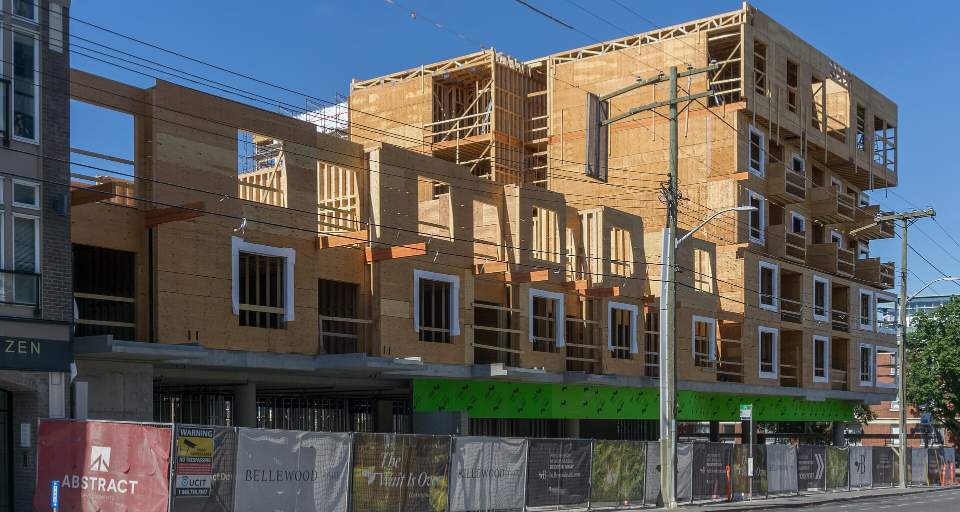
Condo buying guideMortgage financingAsk a questionPhoto from Wikimedia Commons, used under the licence linked in the caption.