


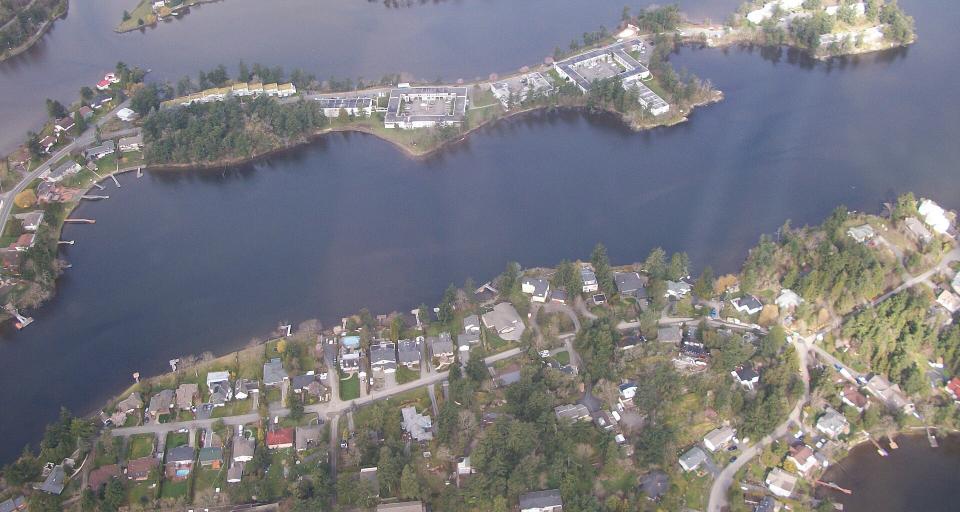
Published October 2026. LTSA fees and BC statutes checked October 30, 2026.
A title search is one of the most important documents in a BC property purchase, and many buyers never read past the owner's name. It shows who owns the land, exactly what the land is, and every registered interest someone else holds in it: mortgages, liens, rights of way, easements and covenants. Some of those charges disappear when you complete; others bind you, and every owner after you, for as long as they stay on title. This guide explains how to order a search, how to read each section, which charges are routine and which are red flags, and how to protect yourself in an offer.
In this guide
- How BC's land title system works
- Ordering a title search
- Reading a title, section by section
- A sample title, explained
- The charges, one by one
- Routine or red flag?
- What survives completion
- Getting the documents behind a charge
- Surveys and title insurance
- Your lawyer or notary
- Strata titles
- Greater Victoria issues
- A subject-to-title clause
- Checklist
- Questions and answers
How BC's land title system works
Land title in British Columbia is based on the Torrens system, and the register is run by the Land Title and Survey Authority (LTSA) under the Land Title Act. The key idea is that ownership changes only when it is registered. The register itself is the proof: an indefeasible title is conclusive evidence that the person named owns the land in fee simple, the fullest form of ownership. The flip side is that an unregistered document, such as a signed but unregistered transfer or mortgage, generally does not pass an interest in land to anyone except as against the person who signed it. That is why your lawyer or notary registers your transfer and mortgage on completion day.
Indefeasibility has limits. Section 23(2) of the Act lists matters that can bind an owner even though the title looks clean. The practical ones for a buyer are:
- Conditions and reservations in the original Crown grant or another Crown disposition.
- Taxes and municipal charges, including unpaid local improvement charges, which is why your lawyer checks property taxes separately.
- Short leases. A tenancy of up to three years with someone in actual occupation binds you without registration.
- Highways, public rights of way, watercourses, water rights and other public easements.
- Expropriation rights under any Act.
- Boundary errors, where land was wrongly included in a title because of a wrong description of boundaries or parcels.
- Fraud in which the registered owner took part.
The LTSA describes title fraud as exceedingly rare in BC. If a registration error or fraud does cost an owner, the provincial Assurance Fund can compensate, and the LTSA's Parcel Activity Notifier, a title monitoring service, emails a legal professional when an application may affect a title.
Ordering a title search
You do not need a lawyer to see a title. You need the property's Parcel Identifier (PID), a nine-digit number usually written in three groups of three, or its legal description. A street address will not work: the LTSA does not allow title searches by civic address. You can find the PID on a BC Assessment notice or property tax notice, through BC Assessment's free online search, or through the LTSA's ParcelMap BC.
LTSA Explorer account
- A single-user online account for people who order a few records a year.
- Search by PID, then order copies of documents and plans.
- Current titles only; cancelled or historic titles need a professional.
Agent, lawyer, notary or registry agent
- Your real estate agent, lawyer or notary can pull the title and charges.
- Registry agents can retrieve older records and research history.
- LTSA staff will not interpret a record for you.
State of Title Certificate
- A copy of the title certified correct when issued.
- Used for court, records or to confirm a change was registered.
- Ordered online, through a professional, or by mail to the New Westminster office.
| LTSA fee, as at April 1, 2026 | Amount |
|---|---|
| Title search (current title) | $11.06 |
| Copy of a registered document or plan | $17.78 |
| Certification, such as a State of Title Certificate | $16.76 |
| Standard electronic transaction fee | $3.55 |
| Manual retrieval of a record not yet imaged | $49.35 |
GST and PST apply where applicable. The LTSA does not take title or document orders by phone or email, and its front counters in Victoria, New Westminster and Kamloops are open by appointment only. A title search does not show past owners or a phone number; for the chain of ownership you need a registry agent or other professional to research historic titles.
Reading a title, section by section
A title search printout follows the same layout every time. The LTSA's sample title shows the order below.
| Section | What it shows | What to check |
|---|---|---|
| Header | The statute the title was issued under (a strata lot shows the Strata Property Act), the land title district and office, the title number, the title it came from, and the dates the last application was received and entered | That it is a current search, dated close to your offer |
| Registered Owner in Fee Simple | Owner names, mailing address and, for more than one owner, whether they hold as joint tenants or tenants in common | That the names match the sellers on your contract. Unless joint tenancy is stated, co-owners hold as tenants in common |
| Taxation Authority | The body that levies property tax | Who to ask about taxes and any local service charges |
| Description of Land | The PID and legal description, usually a lot number, other descriptive numbers and a plan number | That it matches the listing and contract; for a strata lot, the strata plan and the share of common property |
| Legal Notations | Matters other than ownership, such as a heritage designation notice or an easement that benefits this land | Every notation, and the document number it refers to |
| Charges, Liens and Interests | Each charge, with its nature, registration number, date and time, the party who holds it, and remarks | Every registration number. Order the document behind any charge you do not fully understand |
| Duplicate Indefeasible Title | Whether a paper duplicate title is outstanding; usually none | An outstanding duplicate blocks a transfer until it is returned to the land title office |
| Transfers | Pending or recorded transfers; usually none | Anything listed here before your own transfer |
| Pending Applications | Applications received and time-stamped but not yet registered | What each one is: a discharge is good news, a lien or a transfer to someone else is not |
A sample title, explained
The summary below is an illustrative example for a hypothetical detached house. The names, numbers and parcel are invented and do not describe any real property.
| Entry (hypothetical) | What it means | Verdict |
|---|---|---|
| Owner: SAMPLE, ALEX and EXAMPLE, JORDAN, as joint tenants | Both must sign the contract and transfer; if one has died, the survivor owns it by survivorship | Routine |
| Land: PID 000-000-000, Lot 1, Plan VIP00000 | Matches the listing and the contract | Routine |
| Legal notation: benefit of Easement CA0000003 over neighbouring Lot 2 | This lot has a right over part of the neighbour's land, for example a shared driveway | Helpful |
| Statutory Right of Way CA0000010, in favour of the municipality | A sewer main along the back lot line; no building over the right of way area | Routine |
| Covenant CA0000011, in favour of the municipality | A section 219 covenant from a geotechnical report on the slope; the land may be used only as the engineer certified | Read it |
| Easement CA0000012, in favour of Lot 3 | The neighbour can cross part of this lot, for example to reach a garage | Read it |
| Mortgage CA0000020 and Assignment of Rents CA0000021, Example Bank | The seller's mortgage; paid from sale proceeds and discharged after completion | Cleared |
| Claim of Builders Lien CA0000030, Example Renovations Ltd. | A contractor says it was not paid for work on the house | Must clear |
| Pending application: discharge of an older mortgage | A paid-off mortgage is being removed | Good news |
In this example, the right of way and the seller's mortgage are routine, the covenant and the easement need reading before you remove subjects, and the builders lien must be cleared before completion.
The charges, one by one
The Land Title Act calls an interest in land short of full ownership a charge. The LTSA lists mortgages, rights of way, easements, covenants, judgments and builders liens as the common ones. They fall into two groups: money claims, which the seller normally has to clear, and rights over the land, which normally stay.
Money claims against the owner
Mortgage and assignment of rents
A mortgage secures a loan against the land. An assignment of rents, often registered with it, lets the lender collect rent directly from tenants if the owner defaults. Both are normally paid and discharged from the sale proceeds.
Claim of builders lien
Secures a claim for unpaid work or materials. It must generally be filed within 45 days after the work is completed, and it is extinguished unless the claimant sues and registers a certificate of pending litigation within one year of filing. A court can cancel it if security is posted.
Judgment
Once registered, a judgment is a charge on all the debtor's land. It stops binding the land two years after registration, or after its last renewal, unless it is renewed.
Certificate of pending litigation (CPL)
Shows that a court action claims an interest in the land. While it is registered, the registrar generally will not register dealings that affect the land, so a CPL can stop a sale from completing.
Caveat
A warning lodged with the registrar's leave that blocks registration of other dealings. It lapses after two months unless the caveator starts an action and registers a CPL.
Priority agreement
One chargeholder agrees to rank behind another, for example a lender agreeing that a municipal covenant comes first. It changes order, not substance, and is usually routine.
Rights over the land
Easement
A right attached to one parcel to use part of another, such as a shared driveway, path or drainage line. It runs with both properties. Check the area, maintenance and cost-sharing terms.
Statutory right of way (SRW)
Under section 218, a right for the Crown, a municipality, regional district, public utility and certain others to use part of a property for their works, such as sewer, storm, water, power or telecom lines. No neighbouring parcel is needed.
Section 219 covenant
Can be positive or negative, and can control the use of land or buildings, building, subdivision, separate sale, or protection of land and amenities, including keeping land in its natural state. It runs with the land and binds every future owner.
Restrictive covenant and building scheme
A restrictive covenant limits what an owner may do, for the benefit of another parcel. A building scheme, registered under section 220, imposes common restrictions across a subdivision, such as on building types or uses.
Lease
A registered lease binds a buyer for its term. Remember that an unregistered tenancy of up to three years, with the tenant in occupation, binds you too.
Option or right of first refusal
An option gives someone the right to buy the land on set terms; a right of first refusal gives them the chance to match an offer. Either can derail your purchase if it is not waived or discharged.
Section 219 covenants you will meet in Greater Victoria
| Covenant type | Usual purpose | What to check |
|---|---|---|
| Geotechnical or hazard | Land subject to slides, rockfall, erosion or flooding may be used only as an engineer certified | The report it refers to, and whether your plans fit |
| Floodplain | Minimum floor elevations, setbacks, no habitable space below a level | Basement use, insurance, any suite plans |
| Tree protection or natural state | Trees or areas that must be kept | The plan showing the area; landscaping limits |
| No-build or building envelope | Parts of the lot where nothing may be built | Room for an addition, garage or garden suite |
| Environmental | Watercourse buffers, riparian areas, contamination management | Restrictions and any monitoring duties |
| Housing and rental | Affordability, occupancy or rental terms on some newer units | Who may buy or live there, and resale limits |
Routine, worth a look, or red flag?
| On the title | Rating | Why |
|---|---|---|
| Municipal, BC Hydro or telecom right of way | Routine | Very common; check the location before planning additions |
| Seller's mortgage and assignment of rents | Routine | Paid out and discharged from the proceeds |
| Priority agreement | Routine | Only changes the order of charges |
| Section 219 covenant | Read it | May limit building, use, trees or suites, and binds you for good |
| Easement over your land | Read it | Someone else can use part of your lot |
| Building scheme or restrictive covenant | Read it | May limit building height, style, suites or uses |
| Registered lease, option or right of first refusal | Read it | Must be dealt with before you can get clean title or vacant possession |
| Builders lien, judgment or CPL against the seller | Red flag | Must be cleared; a CPL can stop registration altogether |
| Caveat, outstanding duplicate title, or an unexplained pending application | Red flag | Can block or delay your transfer |
| Owner names that do not match the sellers | Red flag | Estate, power of attorney or authority issues to sort out first |
What survives completion
Usually cleared
- The seller's mortgages and assignments of rents. The seller's lawyer or notary pays them from the sale proceeds and registers the discharges after completion, under professional undertakings.
- Builders liens, judgments, CPLs and caveats against the seller. These must be paid, cancelled or otherwise dealt with so your transfer can register cleanly.
- Other financial charges registered by the seller's creditors.
Usually stay
- Easements burdening or benefiting the land.
- Statutory rights of way for municipal works and utilities.
- Section 219 covenants, building schemes and restrictive covenants.
- Registered leases and other interests you agree to take subject to.
- Legal notations such as a heritage designation notice.
Your contract of purchase and sale decides which charges you must accept. The standard BC form generally accepts reservations in the original Crown grant, covenants and rights of way held by utilities and public bodies, and existing tenancies, and expects the seller to deliver title free of financial charges. Anything else you are prepared to live with, such as a private easement or a building scheme, should be identified, and reviewed before you remove subjects. A covenant holder can agree in writing to modify or discharge a section 219 covenant, but that takes the holder's cooperation and time, so do not buy assuming a charge will go away.
Getting the documents behind a charge
The title shows only a one-line summary of each charge. The real terms are in the registered document, and you can order it with the registration number shown on the title.
- List every registration number in the Charges and Legal Notations sections, including entries marked as benefiting your land.
- Order each document through an LTSA Explorer account, your agent or a professional, at $17.78 each plus the transaction fee. Plan numbers come from the legal description or from inside the document.
- Order the plans too. An easement or right of way often refers to a plan that shows where it runs; a description alone rarely tells you if it crosses the spot where you want a garage.
- Allow extra time for old records. Older paper or microfilm documents that are not imaged have to be pulled by a registry agent or in person, for an extra retrieval fee.
- Read for the practical effect: where it applies, what it permits or forbids, who maintains what, who pays, whether you must indemnify anyone, and whether it still serves a purpose.
- Ask questions before subjects come off. Your lawyer or notary can explain the legal effect, the municipality can explain its covenant or right of way, and a surveyor can show you where it is on the ground.
Surveys, encroachments and title insurance
A title tells you what land you are buying, by reference to a registered plan. It does not tell you where the fences, buildings and driveways sit in relation to the boundaries. The LTSA cannot help locate boundaries; for that you hire a member of the Association of British Columbia Land Surveyors.
Survey certificate
Often called a building location certificate, it shows the buildings and other improvements in relation to the property lines, and can show right of way and easement areas and setbacks. It is the reliable way to find encroachments: a neighbour's shed over the line, your deck on a sewer right of way, or a fence well off the boundary.
Encroachments
An encroachment can mean removing part of a structure, negotiating an encroachment agreement or easement, or problems when you apply for a building permit. Anything built over a right of way is at risk if the holder needs access to its works.
Title insurance
Usually arranged by your lawyer or notary, and widely used in place of a new survey. Policies typically cover listed title risks such as title fraud and certain survey, encroachment and municipal compliance problems, up to the policy terms.
What it does not do
Title insurance generally does not cover problems you knew about, environmental contamination, or the physical condition of the house. It pays for covered losses after the fact; a survey tells you about a problem before you buy. The LTSA suggests asking your insurer how its coverage works alongside the provincial Assurance Fund.
The role of your lawyer or notary
In BC a lawyer or a notary public completes the conveyance. They search title, review the charges, confirm which ones the contract requires the seller to remove, arrange for discharges, prepare and register your transfer and mortgage, file the property transfer tax return (see the guide to transaction taxes), and handle the money. They will flag unusual charges, but they cannot know your plans for the property unless you tell them, and they are often brought in only after subjects are removed. So review the title and the key documents during your subject period, with your agent's help, and ask your lawyer or notary before subjects come off if anything is unclear. The guide to writing an offer explains how subject periods work.
Strata titles and common property
A strata lot has its own title, issued under the Strata Property Act. Its legal description names the strata lot and strata plan and includes an interest in the common property in proportion to the lot's unit entitlement. Two more records matter:
- The common property record. Charges and legal notations affecting the common property, such as rights of way and covenants over the whole development, are registered here, not on each unit's title. Search it by strata plan number; the search is free with an LTSA account, with fees to order documents.
- The strata plan. The LTSA holds the official plan, which shows the lot boundaries and any limited common property. Order it to confirm whether a parking stall or storage locker is part of the strata lot, limited common property, or simply assigned by the strata.
- Bylaws and records. The land title office will not usually have the latest bylaws. Get current bylaws, minutes, the Form B information certificate and the depreciation report from the strata or its manager.
For the rest of a strata review, see the guides to buying a condo and depreciation reports. The free BC Strata Documentation Inquisitor, available on ChatGPT and Claude, reads uploaded strata documents and produces a red-flag report; use it as an aid to your own review and your professionals' advice, not a replacement for them.
Greater Victoria issues to watch
Heritage designation versus the heritage register
These are easy to confuse and very different. In the City of Victoria, a designated heritage property is protected by a bylaw and may not be altered or demolished without Council approval; changes need a heritage alteration permit. Provincial law requires the municipality to file notice of a designation bylaw, and of a heritage revitalization agreement, in the land title office within 30 days, so these show up on title. A property that is only listed on the heritage register has no protection from the listing alone, and the listing is not filed on title; the owner is notified instead. Victoria can still withhold a demolition permit for a listed building and give it 60 days of temporary protection while it evaluates the property. Always ask the municipality, because register status will not appear in your title search. The City also runs grant programs for heritage-designated houses.
Hillside and hazard covenants
Rocky, steep lots are common in Langford, the Highlands, Metchosin and parts of Saanich. Under section 56 of the Community Charter, if a building inspector considers that land is likely to be subject to flooding, debris flows, erosion, land slip, rockfall, subsidence or avalanche, the inspector can require a report from a qualified professional. If the professional certifies the land as safe only on conditions, the owner must register a section 219 covenant to use the land only as certified, including a promise to reimburse the municipality's costs if the covenant is breached. Read the report the covenant refers to; an addition or suite may need a new one.
Floodplains
Low-lying land near creeks, lagoons and the shoreline may be in a designated floodplain, where local governments can set flood construction levels and setbacks. Flood-related conditions are often registered as section 219 covenants when a building permit or subdivision is approved. Check the covenant, basement use and your insurance.
Tree protection: bylaw or covenant
Several Greater Victoria municipalities protect trees by bylaw, and that protection does not appear on title. Saanich's Tree Protection Bylaw, for example, protects Garry oak, arbutus, Pacific dogwood and Pacific yew once they are 2 metres tall or 4 cm in diameter; Douglas-fir, grand fir, bigleaf maple and western redcedar from 30 cm in diameter; any tree 60 cm or more; and trees retained or planted through a development or other permit. Saanich notes that trees may have additional protection under a tree or natural state covenant registered on title. A covenant shows on the title search; bylaw protection you check with the municipality.
Municipal rights of way for sewer and storm
Some lots, particularly in older neighbourhoods, have a statutory right of way in favour of the municipality for a sewer or storm drain main crossing the yard. The municipality can enter to maintain its pipes, and you generally cannot build over the area. If you are thinking about a garden suite, garage or addition, find the right of way on the plan first; see the guide to secondary suites and Bill 44 zoning.
Agricultural Land Reserve
Large parts of the Saanich Peninsula, and other rural pockets of the region, are in the Agricultural Land Reserve. A title within the ALR should carry a notation that it may be affected by the Agricultural Land Commission Act, but the Commission treats the title only as a secondary reference: some titles with the notation are outside the reserve and some without it are inside, so check the ALC's maps. Inside the ALR, a principal residence is generally limited to 500 square metres of floor area, one additional residence of up to 90 square metres is allowed on parcels of 40 hectares or less if conditions are met, subdivision needs regulation or Commission approval, non-farm uses are restricted, and placing fill may need authorization. Local zoning does not override ALR rules.
A subject-to-title clause
Make your offer conditional on reviewing the title and the documents behind it, with enough time to order and read them. The wording below is an illustrative example in plain language, not a standard form; have your agent or lawyer adapt it to your deal and your plans for the property.
Pair it with your other subjects: financing, inspection, insurance and, for older houses, an oil tank scan (see the oil tank guide). If you plan to build, renovate or add a suite, say so to your lawyer and check the plans for rights of way, no-build areas and covenants before the subject date.
Title review checklist
- Get the PID from the listing, BC Assessment or the tax notice, and pull a current title.
- Confirm the owners match the sellers, and note joint tenancy or tenancy in common.
- Check the legal description against the listing, the contract and, for strata, the strata plan.
- Read every legal notation and look up what it refers to.
- List every charge with its registration number and order the documents and plans.
- Sort the charges: cleared on completion, staying, or red flag.
- For a strata lot, search the common property record as well.
- Ask the municipality about heritage register status, tree bylaws, floodplain and zoning.
- Check the ALC map if the property is rural or on the Saanich Peninsula.
- Decide whether you need a survey certificate, title insurance, or both.
- Put questions to your lawyer or notary before you remove subjects.
Questions and answers
Can I search a BC title by street address?
No. The LTSA does not allow title searches by civic address. You need the nine-digit Parcel Identifier or the legal description, which you can find on a BC Assessment or property tax notice, through BC Assessment's free online search, or through ParcelMap BC.
How much does a title search cost?
As at April 1, 2026, the LTSA charges $11.06 for a title search and $17.78 for a copy of each registered document or plan, plus an electronic transaction fee (the standard fee is $3.55) and applicable tax. A professional who orders it for you may add a service charge.
Does a title search show past owners?
No. A current title shows the registered owners today and the charges on title, not the chain of ownership. Cancelled and historic titles are not available through an LTSA Explorer account; a registry agent or other professional can research them.
Will the seller's mortgage still be on title after I buy?
The seller's lawyer or notary pays the mortgage from the sale proceeds on completion and then registers the discharge, so it may show for a short time after completion. Your lawyer or notary confirms the payout arrangements before releasing your funds.
There is a builders lien on the title of the home I want to buy. What now?
It has to be cleared before you complete. The seller can pay the claim, or apply to court to cancel it by posting security. A lien is also extinguished if the claimant does not start an action and register a certificate of pending litigation within one year of filing. Your lawyer or notary will insist on a clean title or a court order before releasing funds.
Can a covenant or easement be removed?
Sometimes, but do not count on it. A section 219 covenant can be modified or discharged by written agreement between the holder and the owner, and an easement can be released by the owner who benefits from it. Both take cooperation and time, so buy on the assumption that the charge stays.
Will heritage register status show on the title?
No. A heritage designation bylaw and a heritage revitalization agreement must be noted on title, but a listing on a community heritage register is not; the owner is notified instead. Ask the municipality directly. In Victoria, a listed building can be given 60 days of temporary protection when a demolition permit is sought.
Is title insurance a substitute for a survey?
Partly. Title insurance can pay for certain covered survey and encroachment problems after the fact, and many buyers and lenders rely on it instead of a new survey. A survey certificate from a BC land surveyor tells you before you buy where the buildings sit in relation to the lines and any rights of way. If you plan to build near a boundary or a right of way, a survey is worth the cost.
Does a short-term tenancy show on title?
Usually not. A lease or tenancy of up to three years, with the tenant in actual occupation, binds a buyer without being registered. Ask about any tenancy in writing and deal with it in the contract.
Reviewing a title before you buy?
Build the right conditions into your offer and know what to check during your subject period.
Writing an offer in BCBuying a condoAsk a questionPhoto from Wikimedia Commons, used under the licence linked in the caption.